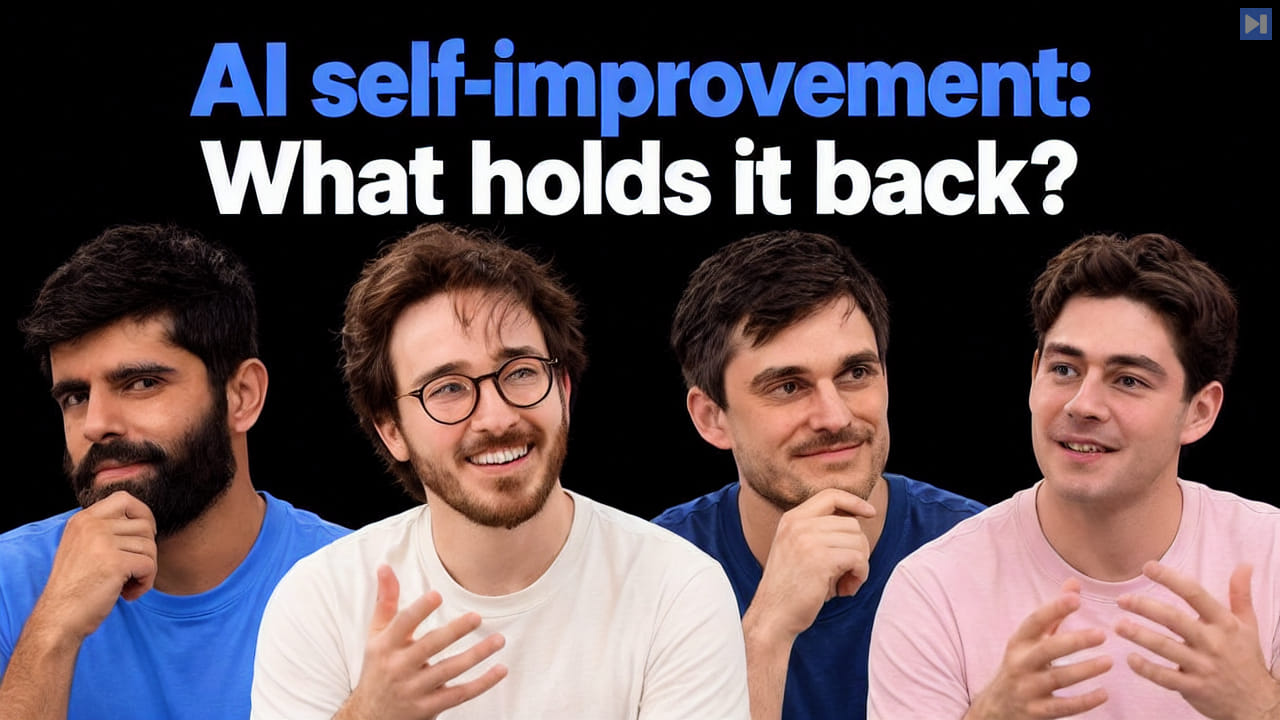
Dwarkesh Patel asks Beren Millidge, John Schulman and Charlie O’Neill what could prevent rapid AI self-improvementRecursive self-improvement is the proposed process in which an AI system helps improve its own capabilities, then uses those improvements to support further advances.. The central distinction is between optimizing a clear research objective and deciding which questions or objectives are worth pursuing. Faster coding and more experiments could accelerate research without automatically replacing scientific judgment or producing an autonomous loop that keeps improving itself.
Dwarkesh Patel, Beren Millidge, John Schulman and Charlie O’Neill examine distillationKnowledge distillation trains a smaller or different AI model to reproduce useful behavior learned from a stronger teacher model. as a force against concentration among model providers. Their discussion distinguishes difficult, easily graded benchmarkA benchmark is a standardized task or collection of tests used to compare AI systems under defined conditions. tasks from realistic work involving changing requests and multiple objectives. A smaller model may reproduce benchmark behavior yet miss useful capabilities if its training prompts do not reflect real deployment.
Dwarkesh Patel, Beren Millidge, John Schulman and Charlie O’Neill distinguish periodic training on deployment traces from a model continuously learning in placeContinual learning lets an AI system acquire new knowledge or skills over time while retaining what it learned earlier.. Small repeated updates can cause forgettingCatastrophic forgetting occurs when an AI model loses earlier capabilities while learning new information or tasks. or reduce general capability, while superficial feedback can be reward-hacked. Company incentives may favor private adapters or other modules over contributing proprietary experience to one shared model.
Dwarkesh Patel, Beren Millidge, John Schulman and Charlie O’Neill discuss how training data, architecture, model size and reinforcement learning interact. Mid-training can establish useful reasoning behavior before reinforcement learning concentrates high-value outcome signals. The panel disputes how much progress reflects general reasoning, longer task persistence or the growing range of environments explicitly included in training.
Dwarkesh Patel, Beren Millidge, John Schulman and Charlie O’Neill finish with uncertain forecasts rather than a shared timeline. Predictions for substantial AI research acceleration range from roughly two years to five to ten years, depending on what counts as researcher productivity. Broad expert-level performance raises additional questions about long-horizon learning, unfamiliar domains and the difference between ordinary remote work and original research.
 Watch on YouTube