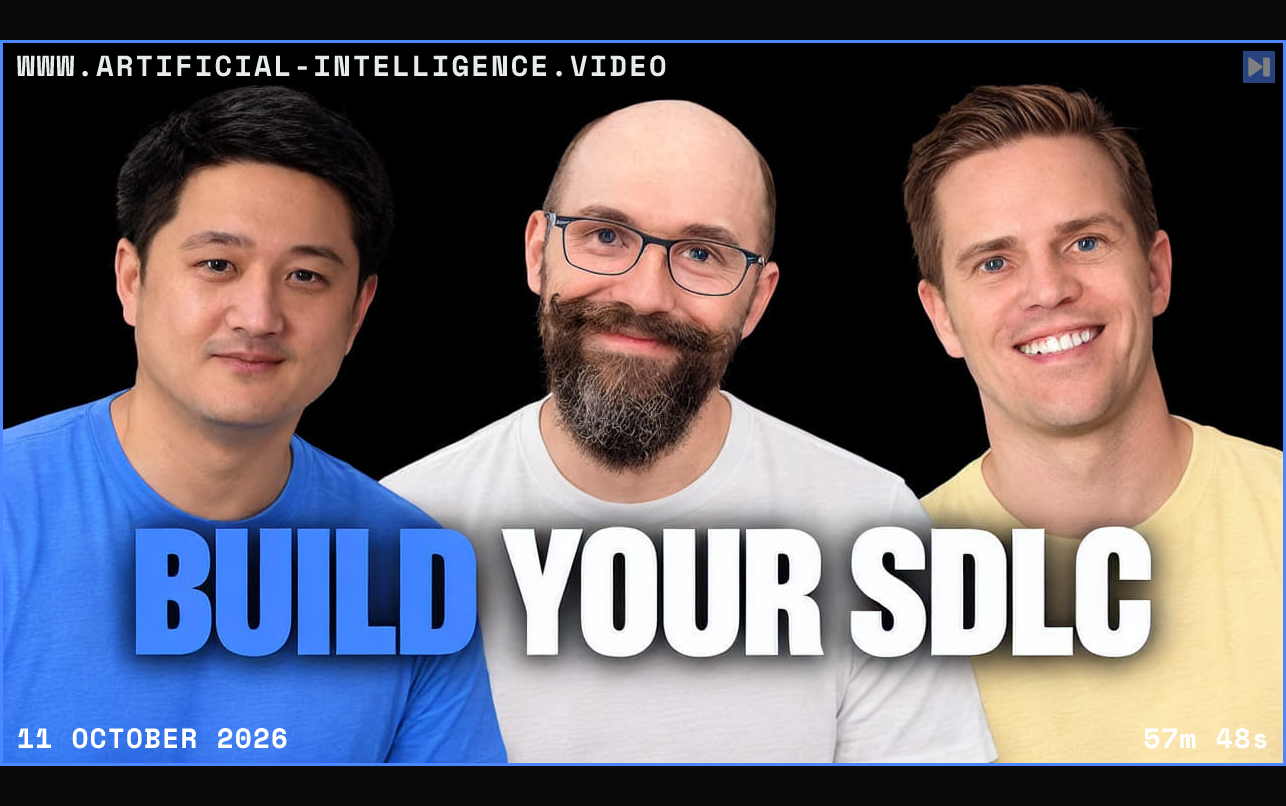
Andy Wong, Andrei Bocan and Shane Wolf outline an agentic software-development lifecycle that extends beyond writing code. Jira coding agents, review standards, planning and incident investigation share organizational information so a task can be understood alongside its requirements and repository context.
The context engine combines current code with connected work items, documentation and historical design decisions. The presenters explain why recent results are useful without automatically being authoritative: humans can verify important documents and resolve conflicting information. Searching current code also helps avoid treating old documentation as a reliable description of today's implementation.
The workshop presents backlog automation as a controlled flow into human-reviewed pull requests. Underspecified tasks need clarification, review workload and spending need limits, and teams should be able to intervene when an agent selects the wrong work. Broader migration and orchestration workflows are described as a direction of development rather than completed demonstrations.
Audience questions expose practical boundaries. Repository instructions drive verification inside a cloud container, model selection is not yet automatic smart routing, and prose standards are not shown as deterministic CI checks. Network problems interrupt the hands-on exercise, so the recording is primarily an explanation and Q&A, not proof of an end-to-end working coding deployment.
 Watch on YouTube