Drake Surach builds a project around a standing goal rather than a one-off request. He distinguishes ongoing work from a temporary initiative, then adds business priorities, editorial preferences and relevant planning files. His central recommendation is specific context that supports the task, not a large indiscriminate collection of documents.
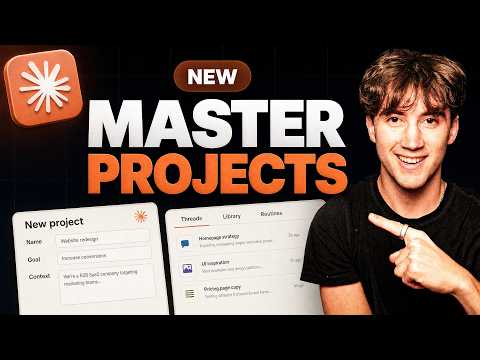
Drake Surach tours the demonstrated workspace's coordinator, threads, library and routines. The coordinator divides a request into focused work and manages dependencies, while individual threads retain their own conversations and outputs. He also shows model and effort settings, describing the displayed defaults rather than proving that those settings are optimal for every task.
Drake Surach demonstrates project instructions and memory using a scheduling preference. The first attempt cannot save it because account-level memory is disabled; after changing that setting, the project retains the preference. This distinction matters because a promise within the current conversation is not the same as durable memory available to later threads.
Drake Surach uploads channel analytics and asks for a four-week content plan. An analysis thread informs a planning thread, which creates editable documents and artifacts. The workflow pauses for a decision about a realistic publishing pace, illustrating human clarification and dependency handling rather than fully unattended execution.
Drake Surach then builds an interactive analytics dashboard and a monthly upload reminder around a reusable template. He resolves a time-zone question and inspects the routine's trigger and instructions. These are demonstrations in his shown environment, not independent verification of broad feature availability, dashboard accuracy or future scheduled execution.
 Watch on YouTube