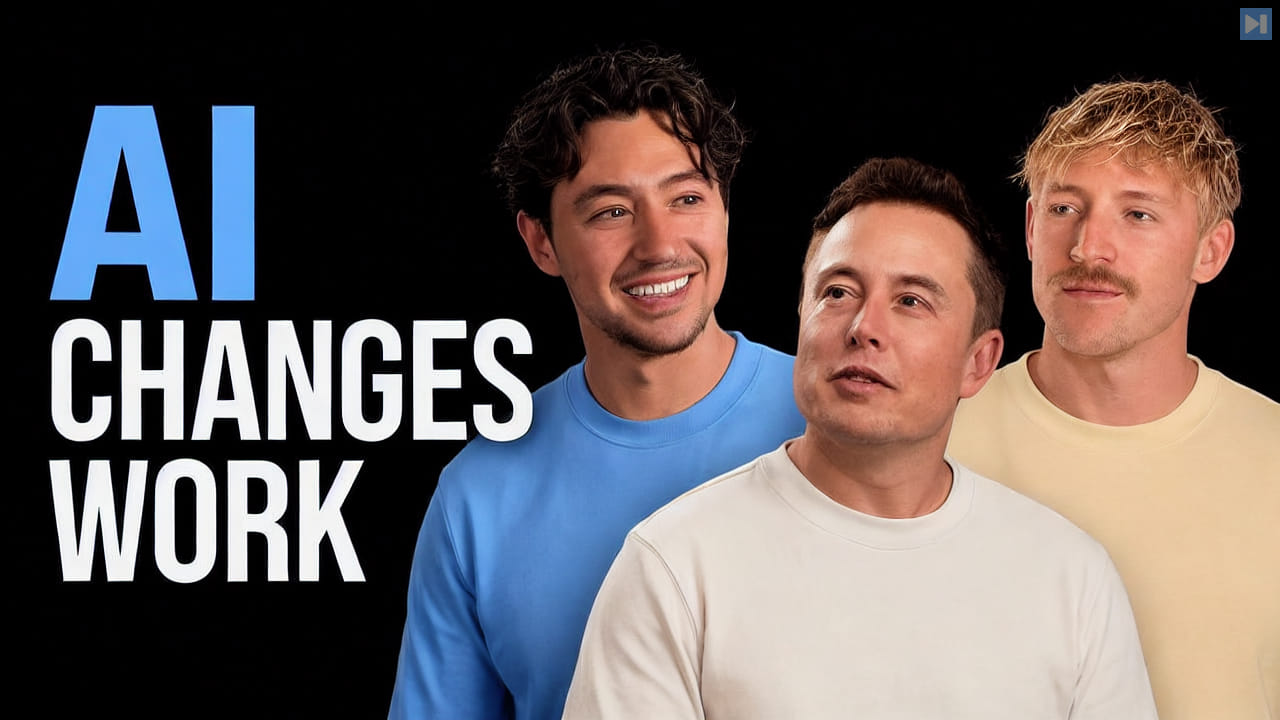
Nick Saraev and Jack Roberts open with a three-year forecast about paid work attributed to Elon Musk, then question what it means for business owners. The discussion acknowledges uncertainty around the timing, contrasts the claim with longer timelines and raises commercial incentives behind dramatic predictions. The practical focus is how businesses can adapt as services become easier to automate, rather than treating the headline’s deadline as established fact.
Nick Saraev describes moving from AI-assisted content writing toward helping businesses adopt AI after accessible chat interfaces weakened the earlier business model. Jack Roberts argues that audience relationships, distribution and trust can remain useful when generated content becomes harder to distinguish from human work. They frame adaptability and businesses that benefit from improving AI as more useful responses than assuming any current skill will retain its value indefinitely.
Nick Saraev and Jack Roberts use an online dispute about an agent product’s interface to discuss unconventional design, usability and changing customer expectations. They distinguish the effort required to build a website from the value a customer receives, emphasizing outcomes, judgment and reputation. Their argument is that cheaper production does not immediately eliminate the value of differentiated design, even though wider availability may eventually make particular styles more commonplace.
Nick Saraev and Jack Roberts discuss a report of higher Nvidia server prices and ask whether model providers would absorb additional costs or pass them to customers. They explicitly note that an effect on token pricing remains unverified. The conversation distinguishes temporary hardware pressures from longer-term improvements in model efficiency, while suggesting that electricity and infrastructure capacity could become increasingly important constraints.
Nick Saraev and Jack Roberts finish by responding to audience questions about model competition, cloud hosting and practical AI use. They caution that a model’s claim about its own abilities is different from demonstrated performance. A brief discussion of health applications also acknowledges that users can be misled when they act on model suggestions without enough knowledge to assess them.
 Watch on YouTube