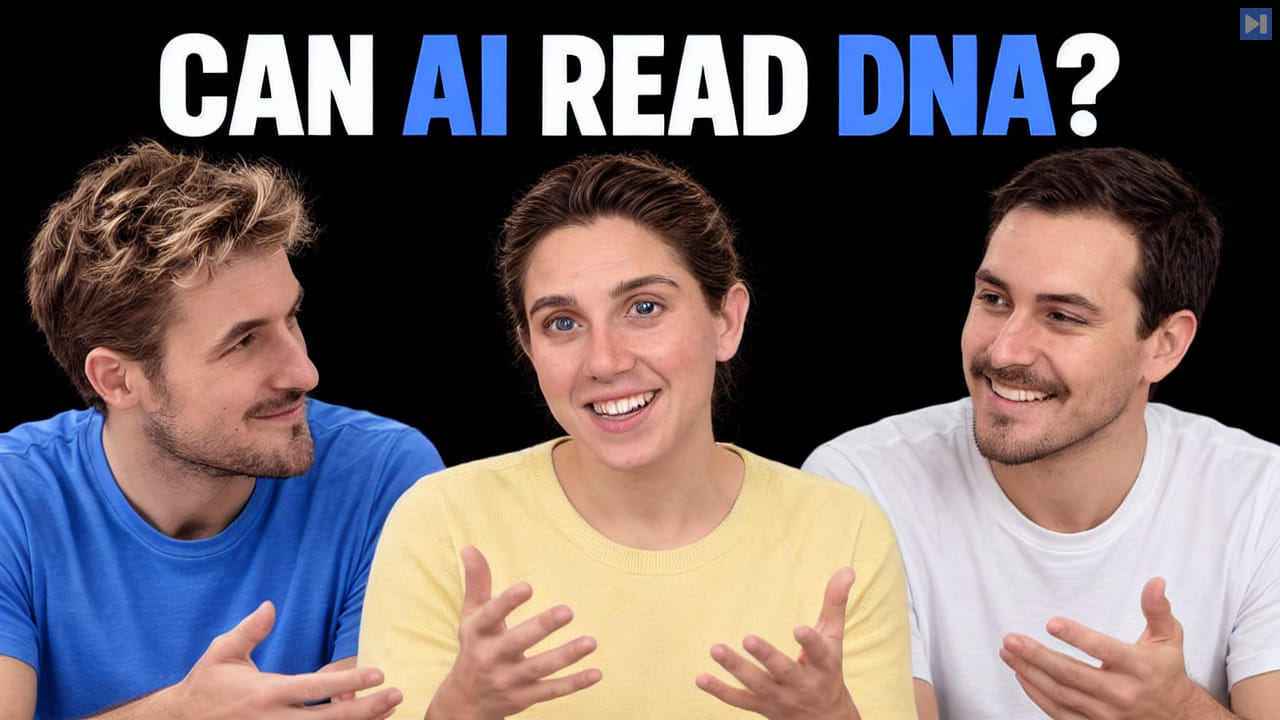
Sophia Kivelson, Pierce Freeman and Richard Diehl Martinez explore Evo Designer through a first-look walkthrough. They compare a genomic prefix with a language-model prompt and examine how the interface extends DNA sequences and displays probability or entropy across individual positions.
Sophia Kivelson explains why conserved regions can receive high likelihood and discusses the Evo research team's comparison with experimental gene-essentiality results. The discussion treats agreement with laboratory findings as useful validation, not proof that every generated sequence would produce a viable organism.
Sophia Kivelson, Pierce Freeman and Richard Diehl Martinez test a repetitive input and consider why predictable repetition can score highly. They distinguish next-nucleotide likelihood from a whole sequence's biological usefulness, while acknowledging evidence of longer-range patterns and the continuing difficulty of verification.
Sophia Kivelson interprets a Goodfire visualization in terms of coding regions, protein structures and possible genome annotations. The group discusses how understandable model features might support research and simpler predictors, but describes several interface interpretations and the clinical example tentatively rather than as independently verified results.
Sophia Kivelson describes feature steering as a promising research direction whose practical success is still uncertain. She also explains virtual-cell research as modeling cellular states and responses to perturbations: useful partial models exist, but a complete, accurate simulation is not presented as an achieved capability.
 Watch on YouTube