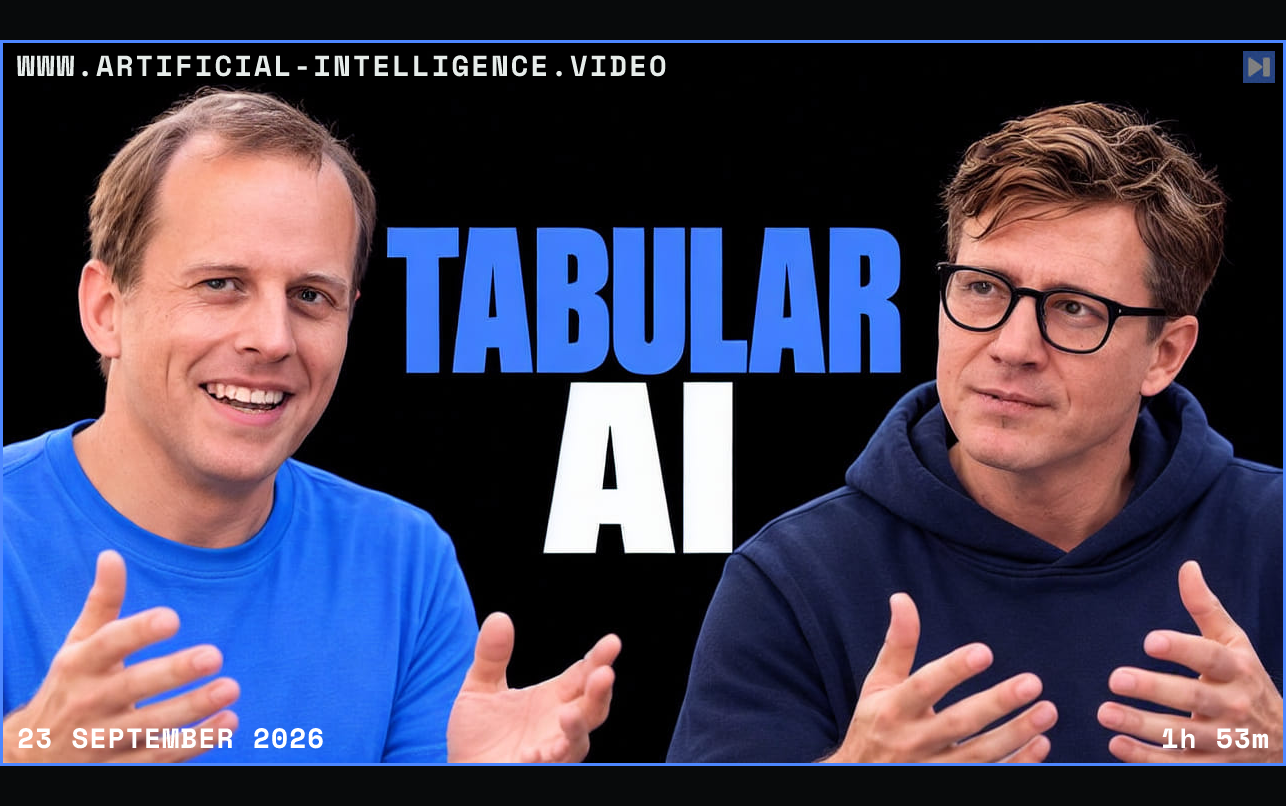
Frank Hutter joins Tim Scarfe to explain why heterogeneous tables have been harder for deep learning than images or text. TabPFN trains across synthetic datasetsSynthetic data is generated rather than directly observed data, used for purposes such as training or testing AI systems. and learns to make predictions from a new dataset in contextIn-context learning is the ability of a model to infer how to perform a task from examples or instructions supplied in its current context., moving much of the search and tuning effort into pretrainingPretraining is an initial training stage that develops reusable AI model capabilities before later adaptation or use on particular tasks. rather than repeating it for every task.
Frank Hutter describes approximating posterior predictive distributions directly, incorporating missing values and categorical features into training priors, and improving row/column representations and inference caching. He distinguishes a fast forward pass from wrappers that spend additional computation and acknowledges limitations on very large or complex datasets.
Frank Hutter and Tim Scarfe discuss coding agents as complements: agents can clean data, add domain-informed features and call a specialized predictor. They also distinguish correlations from interventionsCausal inference investigates how changing one factor affects an outcome, rather than treating an observed correlation as proof of cause., explaining that causal predictions depend on assumptions and can remain non-identifiable. Research ambitions and possible medical applications are not presented as validated deployment advice.
Frank Hutter describes relational data, organization-specific fine-tuningFine-tuning continues training a model on selected data so its behavior becomes better suited to a task, domain or operating environment. and centralized governance, then supplies a recorded TabPFN 3.5 update. Reported benchmark improvements and historical competition results are his claims, not an independent replication. Promotional hiring and contact requests are omitted.
 Watch on YouTube