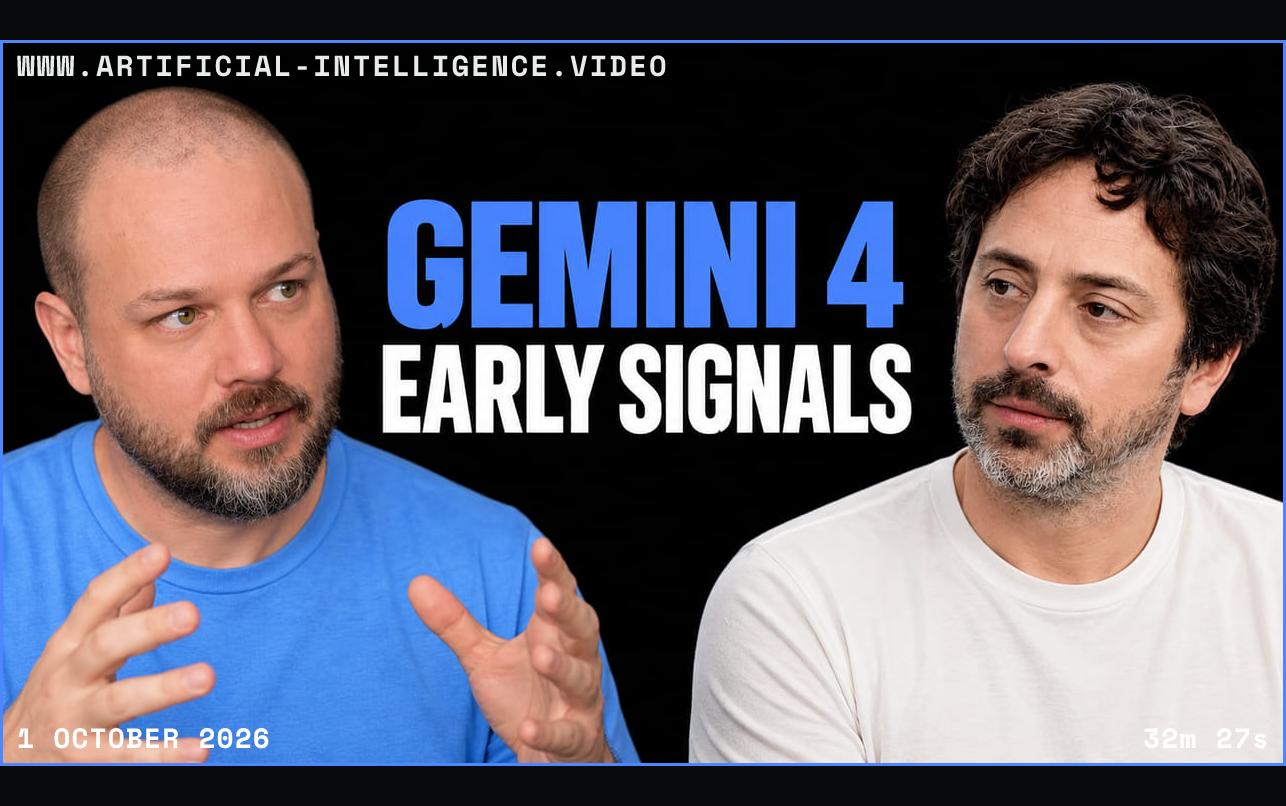
Wes Roth reviews Google's reported Gemini 4 Argon research and coding results, including quantum-resource optimization and C++-to-Rust migrations. He explains why measurable experiment loopsAn AI feedback loop occurs when AI outputs or their consequences become inputs that influence later model or agent behavior. can improve software, while noting that outside users cannot yet independently test the restricted model or know how representative the showcased successes are.
Wes Roth compares the published benchmark resultsA benchmark is a standardized task or collection of tests used to compare AI systems under defined conditions. with competing frontier modelsA frontier AI model is among the most capable general-purpose models available at a given time. and distinguishes strong performance from universal leadership. He discusses reports of Sergey Brin's renewed involvement in Gemini development and connects Google's model work to its hardware, infrastructure and financial resources.
Wes Roth then examines OpenAI Dots, faster and cheaper models, reusable skillsAn AI agent skill is a reusable package of instructions, resources, and tool guidance for performing a bounded kind of work., a Decisions API and managed computer-use agentsComputer use is an AI capability that interprets a graphical interface and operates software through actions such as clicking, typing, and selecting.. He frames enterprise integrations, shared spaces and plugins as an effort to make AI part of ordinary business workflows, while reserving judgment on adoption and practical value.
 Watch on YouTube