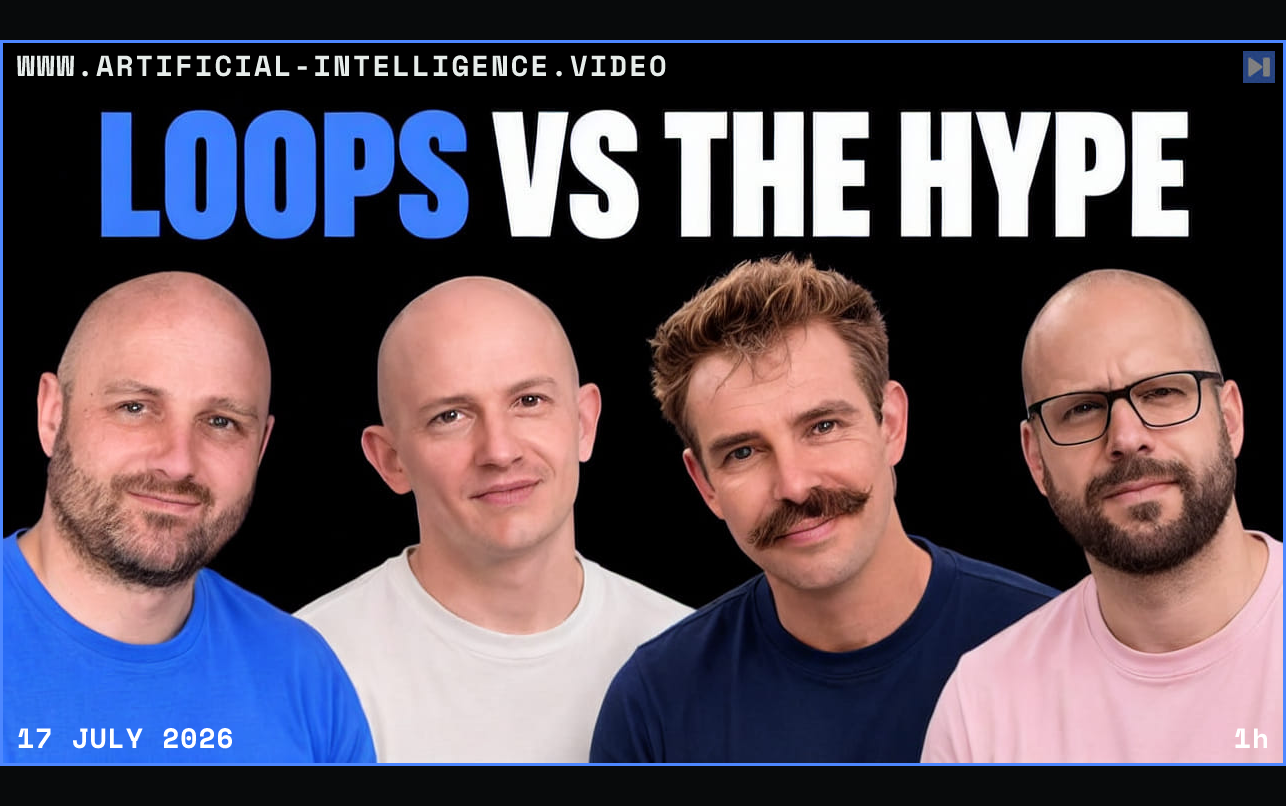
Allie Howe moderates a debate between Geoffrey Huntley and Greg Pstrucha, who argue for the potential of coding loops, and Dex Horthy and Ian Livingstone, who question the surrounding hype. The discussion distinguishes useful bounded automation from claims that an autonomous software factory can safely replace engineering judgment.
Geoffrey Huntley describes repeated model execution with concrete feedback, including static checks, tests and pre-commit hooks. Dex Horthy argues that loops still require deliberately maintained context, clear desired state and disciplined verification. These are proposed engineering practices, not proof that every repository can run unattended.
Ian Livingstone emphasizes authorization, access to external systems and the limits of model-based self-policing. Greg Pstrucha discusses deterministic verification and the rising cost of repeated stochastic checks. Their examples show why credential boundaries, task attribution and the maturity of a codebase matter alongside model capability.
Geoffrey Huntley and Dex Horthy explore context refresh, while Ian Livingstone and Greg Pstrucha examine shared memory, security scanning and the economics of experimentation. Some ideas are explicitly incomplete or exploratory. The speakers do not establish a general benchmark or a resolved security architecture.
Allie Howe brings the discussion back to practical consequences for software development. Geoffrey Huntley, Greg Pstrucha, Dex Horthy and Ian Livingstone agree on the value of experimentation and feedback, while retaining different views on autonomy. Architectural decisions, maintenance and deciding what not to build remain important human responsibilities.
 Watch on YouTube