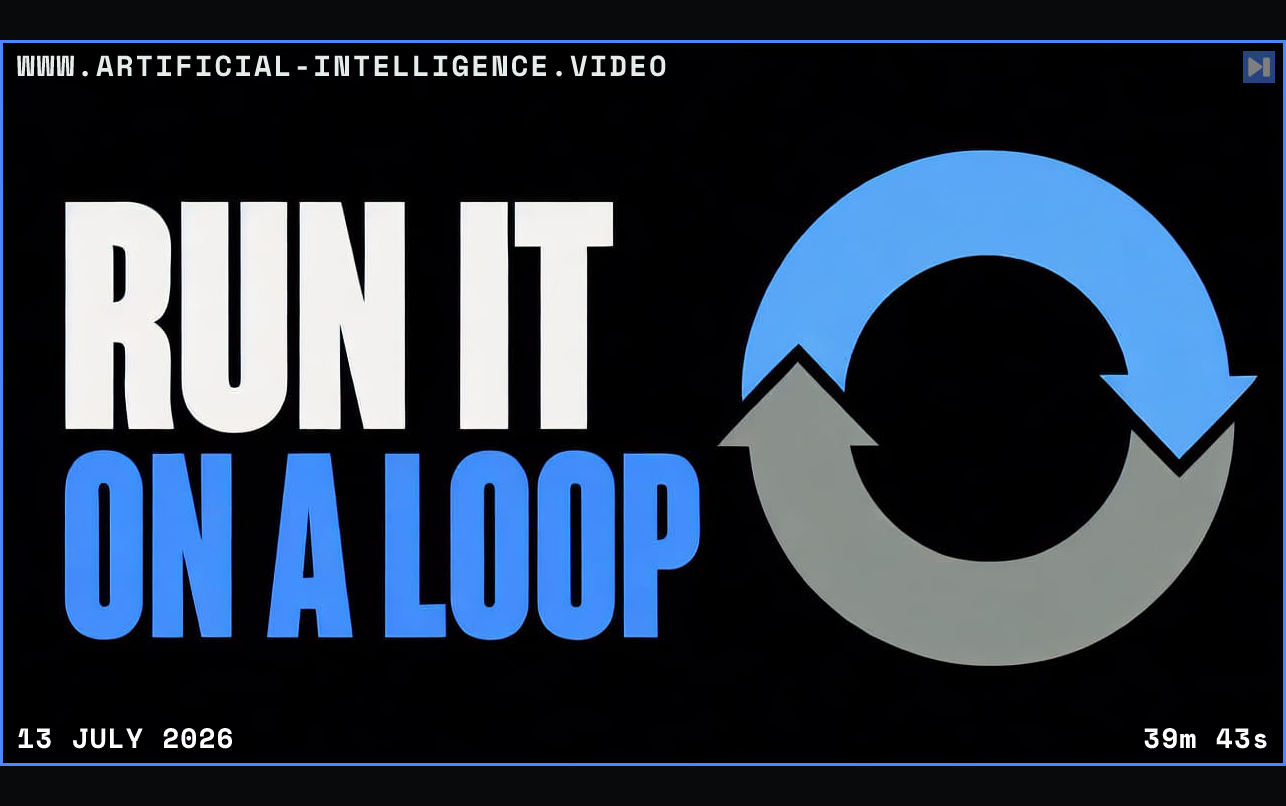
Greg Isenberg and his guest define an agent loop as a repeated build, verify and improve cycle. The agent needs access to relevant tools and data, an objective measure of success, a stopping condition and a durable record of previous experiments so it can learn rather than repeat work.
Their main example is an SEO loop that reads search-performance data, changes a bounded part of a site, waits for results and compares rankings before the next iteration. They extend the same pattern to advertising, where an agent can test copy variants and reallocate effort toward the stronger results while retaining human review for creative quality.
The discussion also considers product-feedback loops that combine customer comments, analytics and error data to prioritize improvements. They recommend separating concerns such as bugs and feature growth, choosing metrics that fit each loop, keeping changes reversible and starting with a small measurable target instead of an open-ended instruction.
 Watch on YouTube