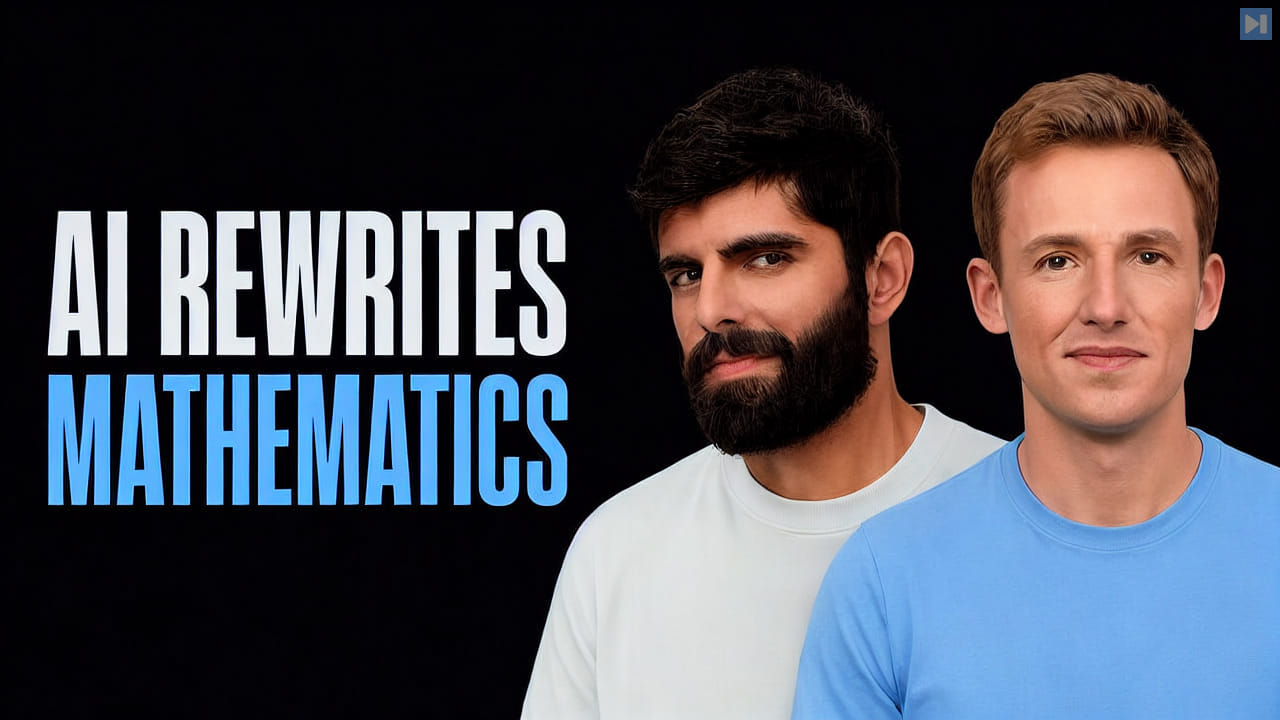
Grant Sanderson and Dwarkesh Patel examine why recent AI results in mathematics are important without treating every benchmark as evidence of general intelligence. They distinguish direct problem solving from the harder work of building theories, finding useful abstractions and connecting distant fields in ways that open new research directions.
Sanderson argues that digital systems have advantages beyond raw capability. Many agents can explore proofs and counterexamples in parallel, restart from different assumptions and combine expertise across fields. Formal systems such as Lean could let automated research continue with machine-checkable correctness, although human or model judgment would still be needed to decide which branches are interesting.
The discussion also separates proof from explanation. Even if AI becomes strong at theorem proving and exposition, mathematicians and educators may remain valuable as curators who choose worthwhile questions, motivate learners and connect new ideas to practical science and engineering. The speakers expect progress to be uneven, with some mathematical advances translating into useful applications more readily than others.
 Watch on YouTube