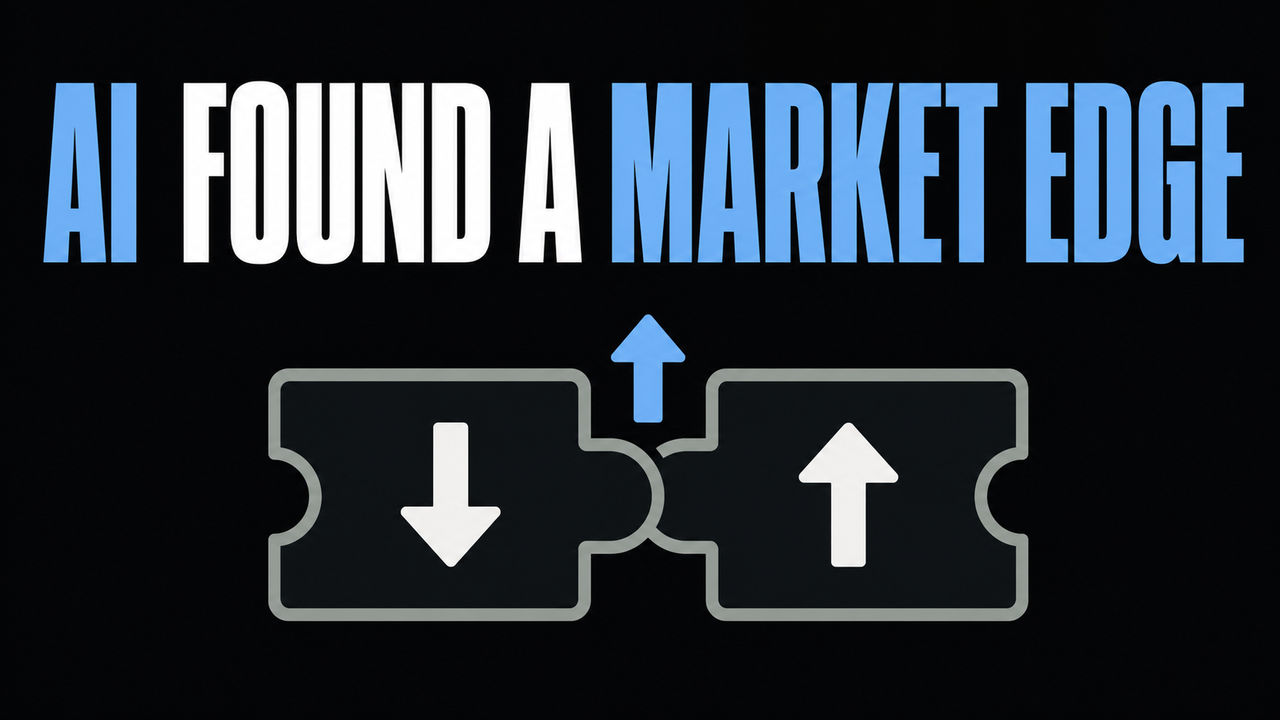
The video begins with a paired position on opposite outcomes of the same prediction-market event. When the combined entry cost is below the eventual payout, filling both sides can lock in a spread. The creator built an automated system that watches for these setups and can merge matched positions instead of waiting for resolution.
The hard part is execution. One side may fill while the other does not, leaving directional exposure instead of arbitrage. The creator says early parameter choices lost money and describes refining order handling over several days to reduce these one-sided fills.
The research workflow gives a coding agent a market's API documentation, a bounded goal and a requirement that every hypothesis be supported by data and expected-value math. A demonstration on new combo markets produces three candidate ideas: long-shot floor capture, same-event correlation trading and payoff-bound arbitrage.
The next step is not immediate live trading. The agent specifies the quote lifecycle, order-book and execution data required to test each hypothesis, and recognizes when public historical data is insufficient. The creator recommends collecting missing data and running paper or shadow trades before risking capital.
The broader claim is that modern models are particularly useful where data cleaning, code and statistical reasoning meet. Most research loops will not find an edge, but continuous experiments can improve the operator's questions and produce reusable infrastructure. The stated return is not treated as a guaranteed future result, and the video itself acknowledges execution and market risks.
 Watch on YouTube