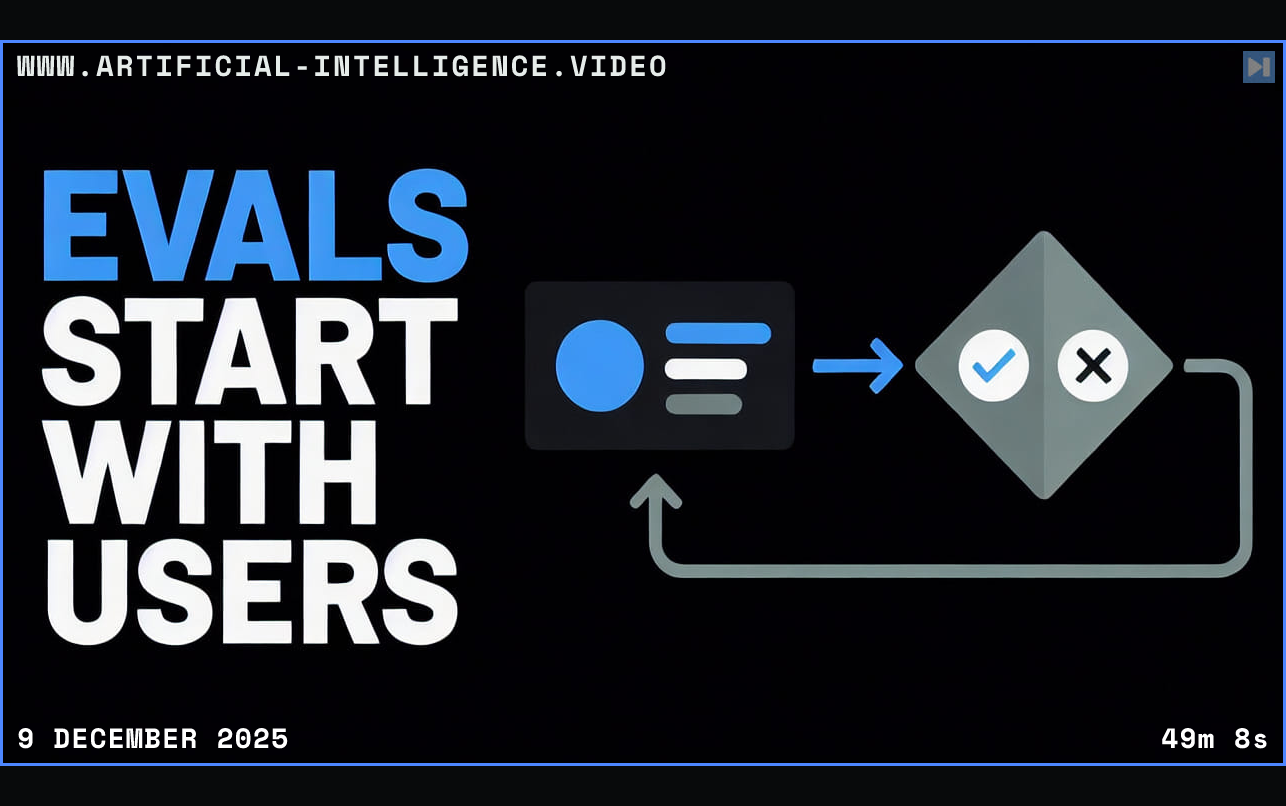
A quick language-model API call can make an AI proof of concept look convincing, but production quality is harder because outputs are stochastic and subjective. Lucek argues that teams must define evaluation alongside development, move from technical scores toward user value and inspect the full trace rather than judging only the final response.
The proposed starting point is a diverse set of realistic queries covering user scenarios and personas. Domain experts then mark outputs as pass or fail and explain why. Error analysis groups those failures into recurring themes, allowing the evaluation rubric to emerge from observed product behavior instead of generic labels such as helpfulness or hallucination.
Once the human baseline is clear, teams can scale it with separate LLM judges for each criterion and simple deterministic checks for formatting or other objective rules. The judges should use capable models, binary decisions and explicit criteria, then be compared with human labels using agreement and classification metrics before they are trusted on unseen data.
Trace and evaluation platforms can monitor inputs, tool calls, retrieval, intermediate reasoning and outputs across product versions. Pairwise tests reveal regressions, while repeated user research catches criteria drift. The talk also explains how a mature evaluation suite can support prompt optimization and reinforcement learning, while warning that fully self-improving loops remain immature. The Brilliant sponsor segment is omitted from these conclusions.
 Watch on YouTube