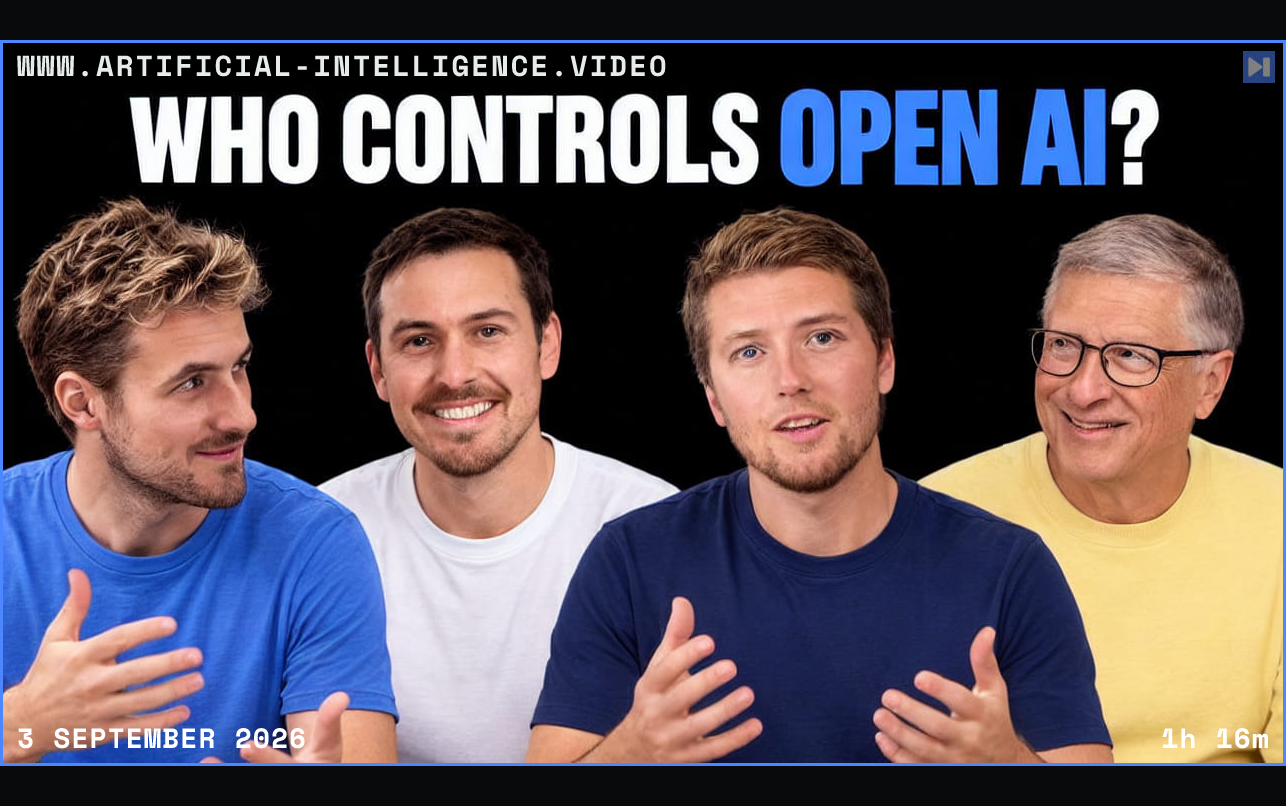
Pierce Freeman and Richard Diehl Martinez discuss a reported Nvidia acquisition of Hugging Face, explicitly noting that neither company had formally announced it in the account they describe. They trace Hugging Face's development from a chatbot project into a community for models, datasets and developer tools, including the roles of Clément Delangue, Julien Chaumond and Thomas Wolf.
Pierce Freeman and Richard Diehl Martinez argue that easier access to open models can increase demand for Nvidia hardware. They view developer distribution as a potential reason for a chip company to value Hugging Face, while treating valuation claims, board pressure and the founders' motives as unverified reporting or speculation. They distinguish neutrality toward model providers from neutrality toward competing chip architectures.
Pierce Freeman and Richard Diehl Martinez discuss the small Micro Duck robot as an example of an approachable reinforcement-learning platform. Their emphasis is on simulation, community experimentation and a playful form factor that sets modest expectations, rather than a humanoid promising to perform every household task. Product specifications and sales figures are the hosts' descriptions, not independent tests.
Pierce Freeman and Richard Diehl Martinez turn to Bill Gates's AI transition proposals as described in the episode. They debate protecting some human work and raising public revenue as automation changes employment. A tax based on tokens is presented as a policy proposal, not an existing rule; they question whether token efficiency and hidden computation make it a poor measure of economic value.
Pierce Freeman and Richard Diehl Martinez close with education and social development. They consider personalized learning alongside concerns about answer-giving and isolated chatbot companionship. They argue that communication, debate and working with other people remain important even as technology changes, while acknowledging that their educational views are opinions rather than demonstrated universal outcomes.
 Watch on YouTube