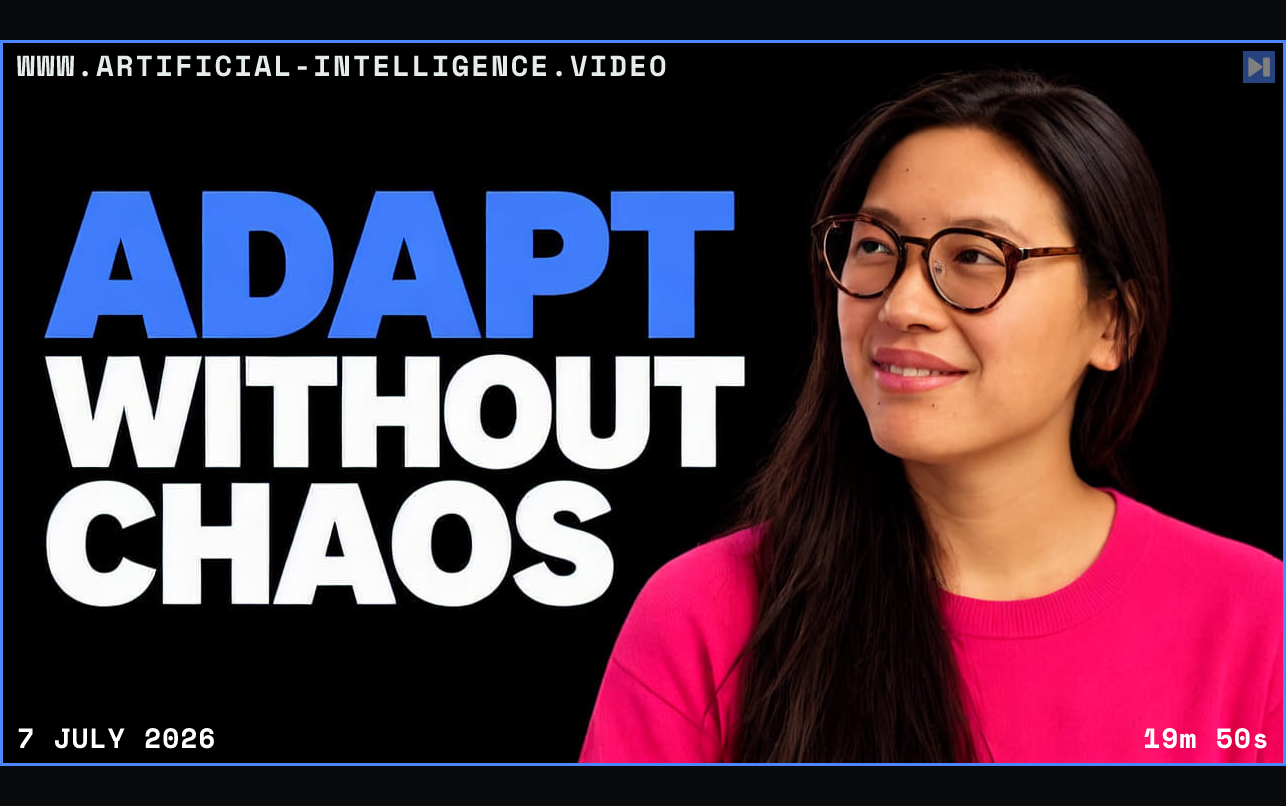
Iris ten Teije challenges the assumption that every user should receive one frozen software artifact. The talk presents falling code-generation costs as an opening for software that adapts during use, drawing on familiar demand for customization in enterprise services, developer tools and spreadsheets. This is an architectural proposal, not proof that software changes are free or automatically correct.
Iris ten Teije describes a common application stem with isolated per-user divergences. Developers would define boundaries, such as protecting authentication, payments or mandatory fields, while each user's permitted adaptations remain inspectable and reversible. A CRM example illustrates how workflows might adapt to an investor rather than assume every user is a salesperson.
Iris ten Teije explicitly identifies unsolved challenges: tracing what a user is running and why, validating many variants, measuring whether a correct change is actually desirable, earning trust in autonomy and propagating shared updates. The talk argues for coordinating intent and outcomes, while treating observability, validation and isolation as essential infrastructure rather than claiming the ordinary release pipeline can simply be removed.
 Watch on YouTube