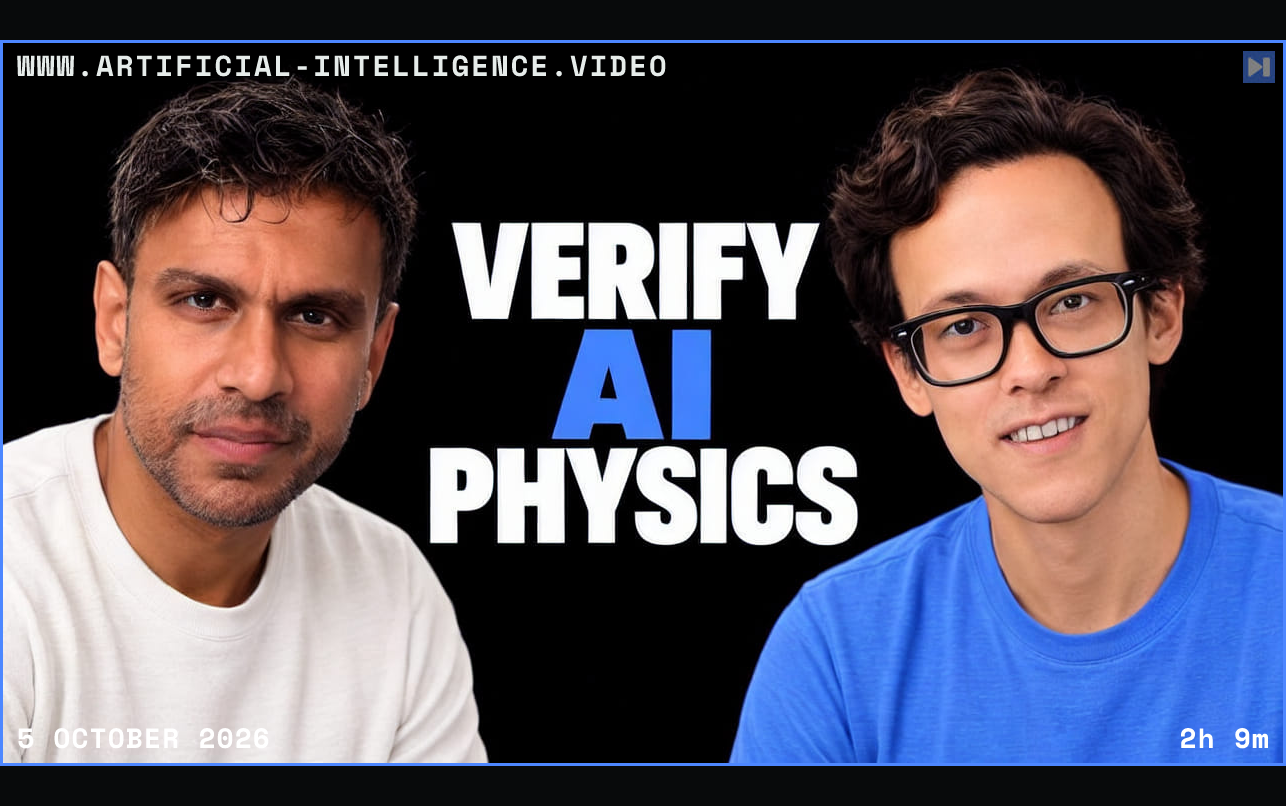
Jonathan Gorard tells Curt Jaimungal that rapid progress in AI-assisted mathematical formalization changed his expectations for scientific work. The discussion distinguishes checking a proof from discovering a new theorem, and acknowledges uncertainty over how much prior human formalization contributed to the sphere-packing example. Jonathan Gorard separates the production of useful results from the curiosity, effort and pleasure of research.
Jonathan Gorard argues that physics presents a harder verification problem than software or mathematics alone. A simulation must be mathematically consistent, respect applicable physical principles and connect its predictions to experimental observations. Measurements themselves depend on models and assumptions; a checked proof does not establish that a specification accurately describes nature.
Jonathan Gorard describes Lanyon AI's neurosymbolic approach: a language model proposes a compact formal specification, while symbolic methods connect that specification to simulation code and proofs. He discusses type systems for physical reasoning, numerical stability and floating-point arithmetic. Broader claims about automating scientific discovery remain his research ambitions, not evidence that a general-purpose verifier for physics is finished.
Curt Jaimungal challenges whether an AI can simply explain its reasoning to people. Jonathan Gorard distinguishes obtaining a valid result from transmitting understanding, and describes a tradeoff between expressive reasoning languages and human-auditable steps. A sequence of individually understandable operations can still be too long to grasp, while a concise representation may depend on unfamiliar concepts. The discussion also considers embodiment and the need to interface with real experimental apparatus.
Jonathan Gorard describes his response to changing research workflows as an effort to preserve the parts of mathematics and physics that he enjoys, rather than automate every activity. He remains optimistic that curiosity-driven science can find a new equilibrium, but explicitly treats its timing and social disruption as uncertain. The closing research discussion covers numerical proof assistants and mathematically structured neural networks, not a demonstrated replacement for experimental scientists.
 Watch on YouTube