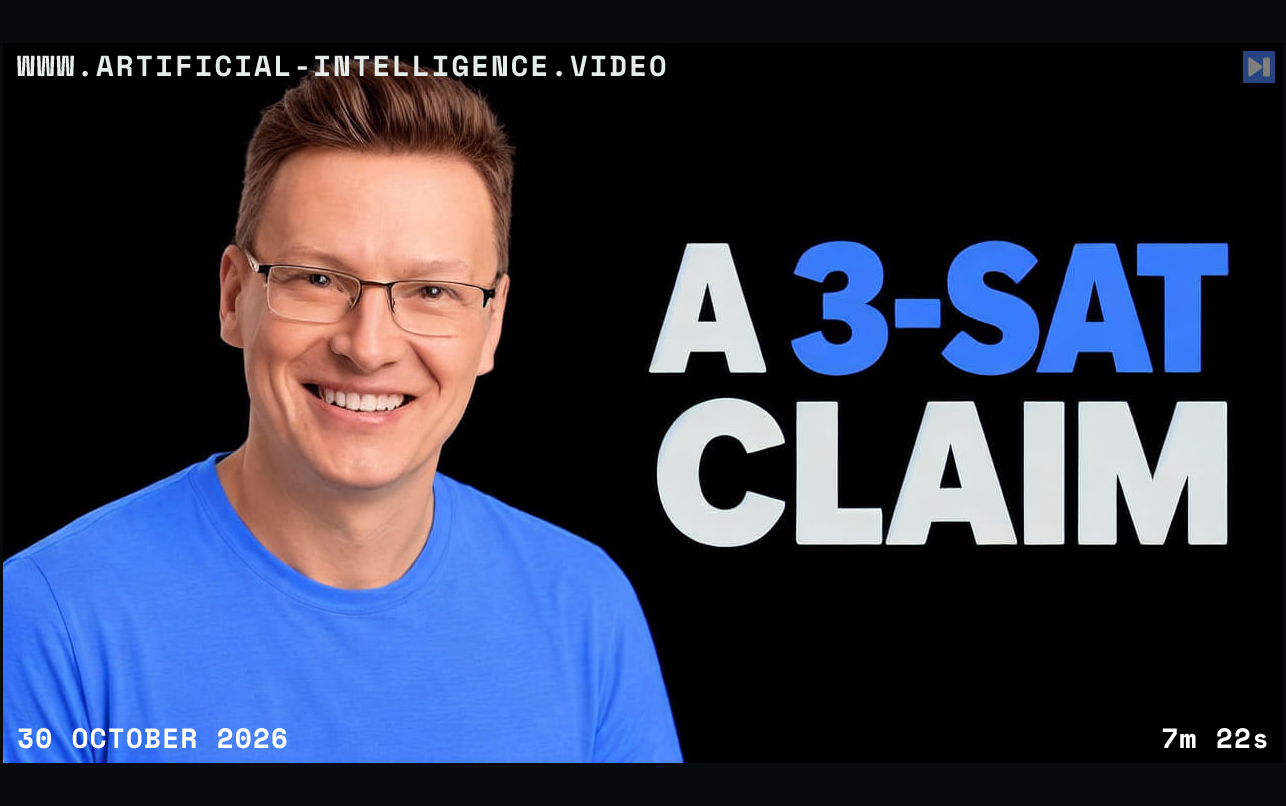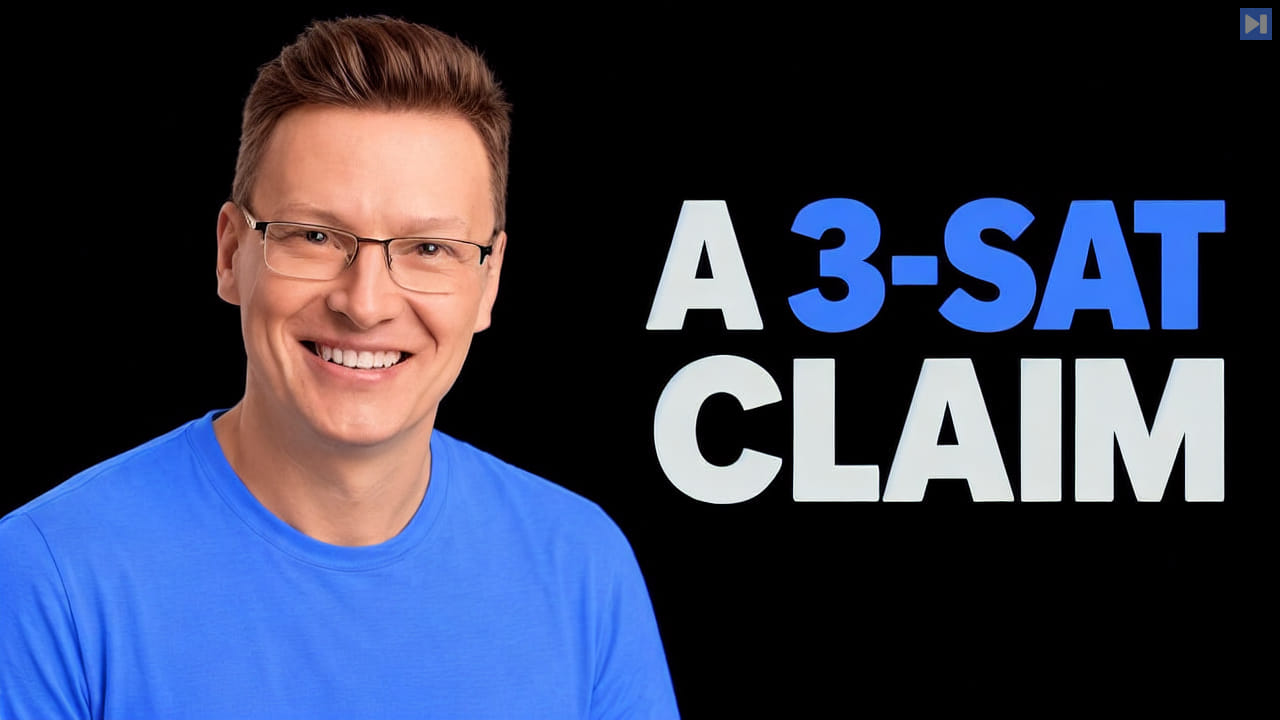
Károly Zsolnai-Fehér introduces 3-SAT using a small logical example3-SAT asks whether true and false values can satisfy a list of rules with up to three choices per rule., then explains how the number of possible assignments can grow as a problem gets larger. The exponential time hypothesisThe exponential time hypothesis says that solving every 3-SAT instance in time subexponential in the number of variables is impossible. concerns the worst-case complexityComputational complexity studies how the resources needed to solve a problem grow as the input becomes larger. of solving such problems.
Károly Zsolnai-Fehér discusses an OpenAI preprint claiming a sub-exponential algorithm and a refutation of the hypothesis. The claim was awaiting independent verification at the time of the video and should not be treated as an established proof.
The video explains why reductions make satisfiability relevant to other computational problems, while distinguishing the claimed result from a resolution of P versus NP. A faster theoretical bound does not automatically imply practical improvements for every application.
 Watch on YouTube