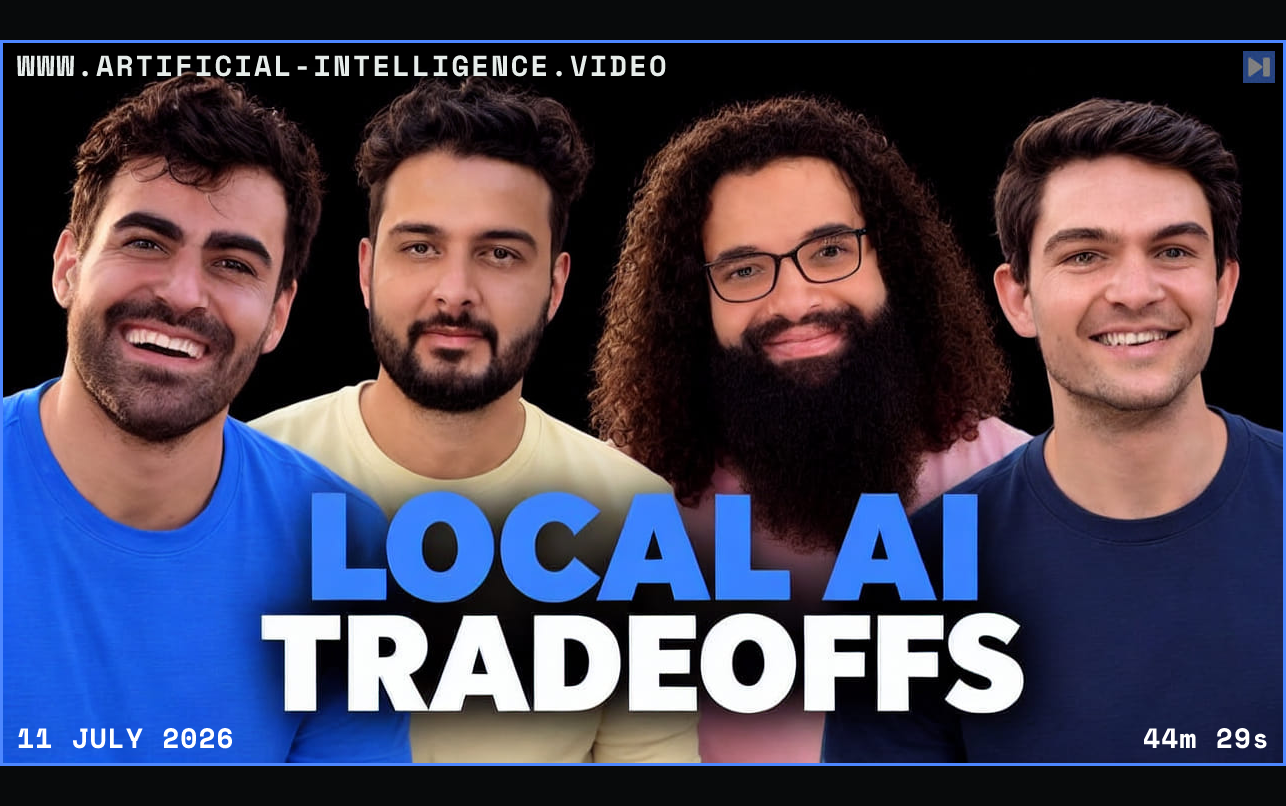
Nader Khalil frames local AI around always-on agents, sensitive inputs and recurring inference costs. Alex Cheema, Ahmad Osman, Joseph Nelson and Matthew Berman describe the combined progress in models, hardware and agent harnesses. Their privacy and control arguments depend on the actual deployment boundary; local weights alone are not a blanket guarantee that tools or data never leave a device.
Joseph Nelson connects language-agent deployment with lessons from computer vision under limited connectivity and compute. Ahmad Osman advocates workload-specific models and collecting traces to decide where each model belongs. The discussion includes hybrid patterns in which a larger model plans while smaller systems execute, but routing and context transfer remain engineering problems rather than automatic savings.
Alex Cheema and Nader Khalil describe a hardware-tuning collaboration that assembled existing techniques for desktop inference. Reported speedups illustrate their experience, not an independently reproduced benchmark. The broader argument is that quantization, configuration and suitable inference software matter alongside the capacity of the hardware.
Matthew Berman emphasizes that local systems still need simpler setup and clearer explanations of which workloads fit particular models and devices. Joseph Nelson describes using general models to curate data for smaller specialized vision deployments, while the panel debates fine-tuning against strong general models with good context. Open-model access, convenient interfaces and reliable workload evaluation remain unresolved adoption questions.
 Watch on YouTube