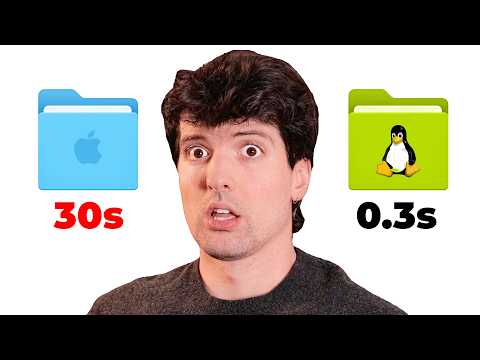
Theo Browne examines a bottleneck that becomes more noticeable when coding agents work in parallel: repeatedly creating worktrees, linking dependencies and cleaning up large collections of small files. In the opening comparison, a cached package installation finishes in under ten seconds on his Linux machine but takes roughly 35 seconds on his Mac. The discussion focuses on local file operations and post-install work, explaining why fast SSD hardware alone does not guarantee a responsive agent workflow.
Theo Browne evaluates file systems through three practical concerns: operation speed, features such as copy-on-write and linking, and compression that reduces physical storage without excessive processing overhead. The comparisons cover APFS, ext4, XFS, ZFS and Btrfs. His tests include individual and parallel worktree creation, dependency installation and deletion, showing why an option suited to general storage may behave differently under a development workload with many small files.
Theo Browne reports that XFS with a VDO compression and deduplication layer gives his Linux development setup a useful balance of speed and capacity. In one comparison involving 125 worktrees with dependencies installed, he reports roughly 75 gigabytes for ext4, 43 gigabytes for APFS and 24 gigabytes for XFS with VDO. Changing the package manager to use hard links also improves a cleanup benchmark in his setup. These are results from his selected repositories and machines, rather than a controlled claim that every application or hardware configuration will show the same gains.
Theo Browne connects the measurements to everyday agent use by comparing the delay between starting a task and completing its worktree setup on Linux and macOS. He also discusses Rift as an alternative approach that virtualizes worktree files and postpones copying until they are changed, while expressing uncertainty about its maintenance. The broader lesson is to evaluate the storage operations that surround agent execution, including their cumulative disk usage, instead of measuring only model response time.
 Watch on YouTube