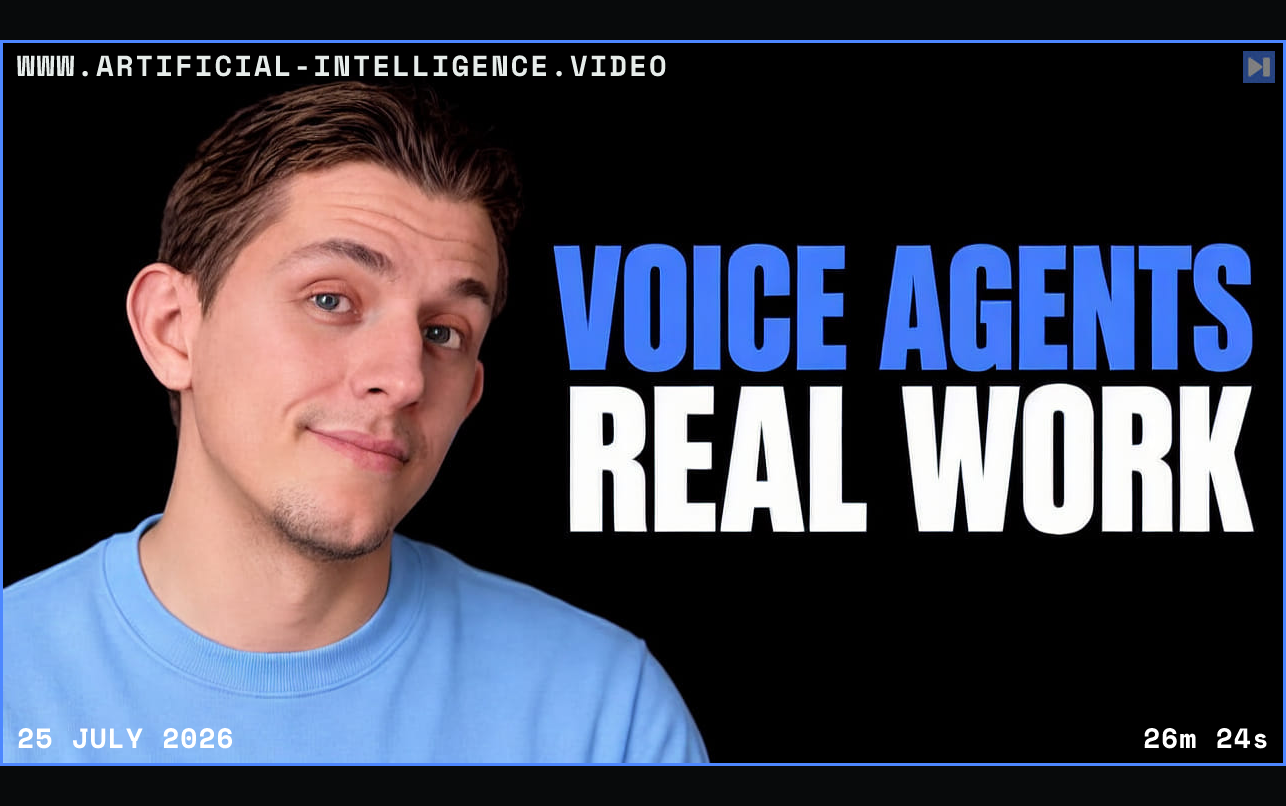
Riley Brown demonstrates voice-led agent workflowsAI agent delegation assigns a bounded task, context, authority, and expected result from one participant to an agent or another agent. around the release of Opus 5. He asks for a presentation, uses connected workspace context and explores email drafts and landing-page work. The presentation includes explicitly requested fictional figures, so it is a workflow example rather than evidence of a real company's performance.
The video compares spoken interactionA voice interface lets people interact with software through spoken input and audible responses. with Claude and Codex, including pauses, follow-up instructions, design variants and remote control of desktop tasksComputer use lets an AI agent interact with software through interface controls such as screens, buttons, keyboards and pointers. from a phone. Brown also encounters interface friction, such as returning to text to obtain a usable link. Asynchronous completion claims are not the same as independent verification of every result.
Brown's broader argument is to invest in repeatable workflowsWorkflow automation uses software or AI to complete a connected sequence of routine steps with less manual effort. and inspectable agent interfaces instead of constantly chasing the highest-ranked model. Skill recordingAn AI agent skill is a reusable package of instructions, resources, and tool guidance for performing a bounded kind of work. and simulator-based interaction are presented as ways to teach recurring tasks; his forecasts about future products remain opinion.
 Watch on YouTube