Pim de Witte explains General Intuition's approach to learning visual policiesA robot policy is the decision-making function that maps observations and goals to actions a robot should take in its environment. from gameplay and other action-labeled video. The interview connects game-controller inputs with interfaces robots already support, aiming to transfer learned behavior without replacing existing locomotion and balancing systems.
Pim de Witte distinguishes policy learning from predicting pixels alone: visible outcomes may omit the hidden actions that caused them. Human action trajectories therefore remain important, even when bot-generated dataSynthetic data is information generated to represent examples or situations rather than collected directly from the events it describes. can teach some environment dynamics. Multi-view world-model trainingA world model learns how an environment is structured and how it may change in response to actions. is discussed as a way to encourage shared spatial structure.
Pim de Witte says transfer becomes harder as embodiment and action spaces become more complex, including humanoid hands not represented in current training dataTraining data is the collection of examples and signals used to adjust an AI model's parameters so it learns useful patterns.. Forecasts about simulation-driven growth and convergence between code and pixel-based intelligence are presented as his expectations, not established results.
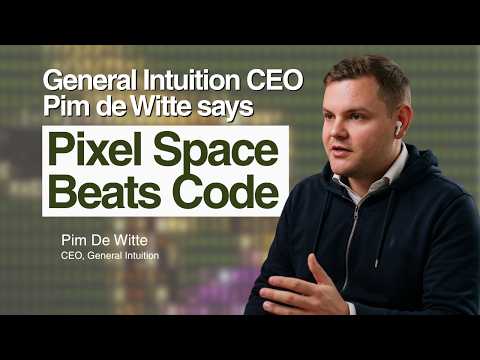 Watch on YouTube