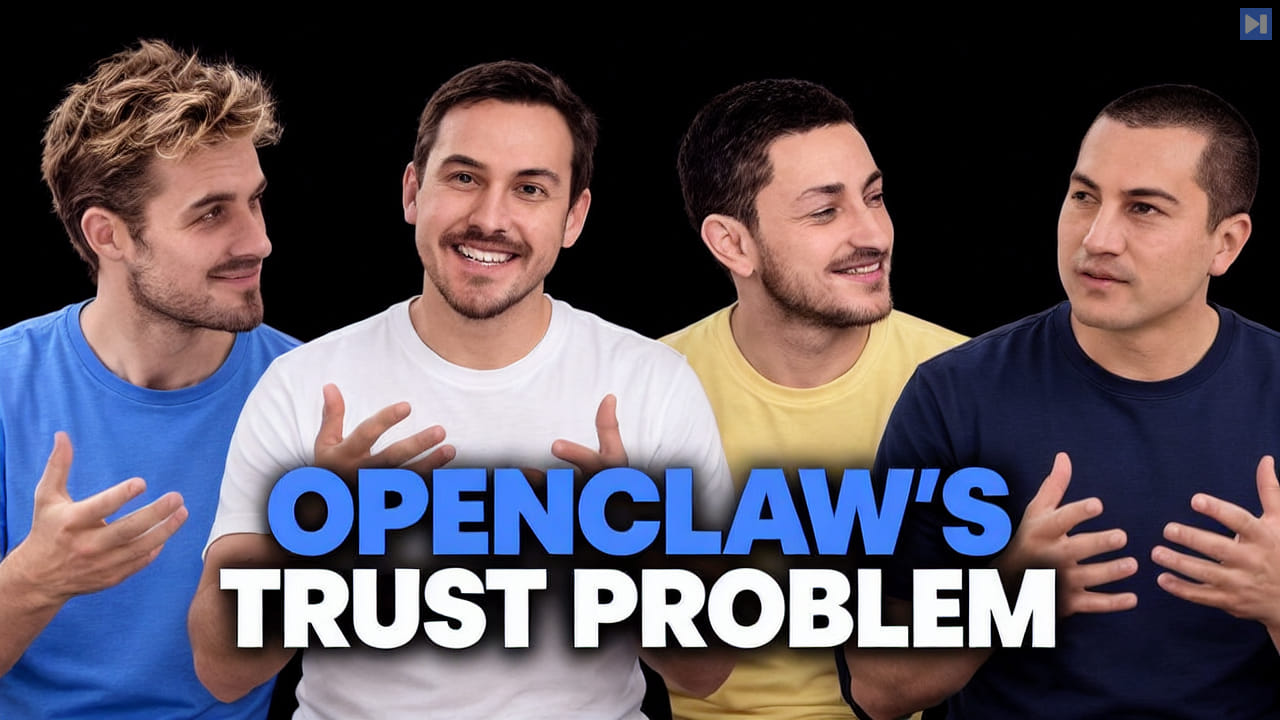
Sam Odio describes OpenClaw as a flexible environment for people who want to build custom workflows rather than accept a fixed product. His examples include connecting messages to a family calendarWorkflow automation uses software or AI to complete a connected sequence of routine steps with less manual effort. and experimenting with a virtualized Mac installation. Hannes Rudolph and Patrick Erichsen explore how less technical users could gain that flexibility through better onboarding and appropriate abstractions.
Sam Odio, Hannes Rudolph and Patrick Erichsen discuss the risks of giving an agent computer access. They compare scoped context, delegationAI agent delegation assigns a bounded task, context, authority, and expected result from one participant to an agent or another agent. and independent reviewHuman-in-the-loop AI keeps a person involved in reviewing, correcting, approving, or guiding an AI system's work. with practices in human organizations and systems engineering. These analogies are design ideas, not proof that prompts or model behavior can enforce security boundaries or eliminate prompt injectionPrompt injection occurs when untrusted content attempts to redirect an AI system's behaviour beyond the authority of that content..
Sam Odio argues that domain expertise and community learning may help more people benefit from agents, while also raising concerns about uneven access and unintended social consequences. His account of earlier machine-learning work is a personal reflection rather than a causal investigation.
Patrick Erichsen describes a practical limit: agents make it easier to begin ambitious projects, but finishing and maintaining them remains difficult. Hannes Rudolph discusses OpenClaw's ongoing coding and orchestration workAgent orchestration coordinates AI agents, tools, people, tasks, state, and control flow so a larger workflow reaches a verified outcome.. Their development plans and current workflows are distinguished from features proven reliable for every user.
 Watch on YouTube