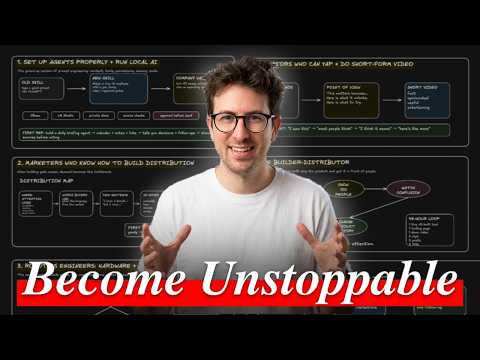
Greg Isenberg's first skill stack moves beyond prompt writing to designing bounded agents with context, tools, permissions, memory, goals and evaluations. He recommends learning on a small daily briefing agent, then using local models when privacy, latency, cost or control make on-device execution useful.
His second and fourth stacks focus on distribution and curation. Distribution means finding where a niche's attention already lives, learning its language and building trust before asking for a sale. Curation adds an informed point of view: identify what matters, explain why and turn that judgment into useful short-form media rather than forwarding undifferentiated links.
The third stack connects AI to robotics and manufacturing. Isenberg suggests assembling a low-cost robot arm, teaching it one constrained task and documenting every failure, while also learning supplier specifications, samples, lead times, repairability and manufacturing constraints. His fifth stack, the builder-distributor, similarly closes a loop by shipping a small product and testing its story with users in rapid cycles.
The final stack is real-world community building, where belonging, trust and context remain scarce even as software and content become abundant. Isenberg proposes starting with a small recurring gathering around one specific question and publishing a useful recap. These are the creator's strategic recommendations, not guarantees about employment or business outcomes, and the closing channel promotion is omitted.
 Watch on YouTube