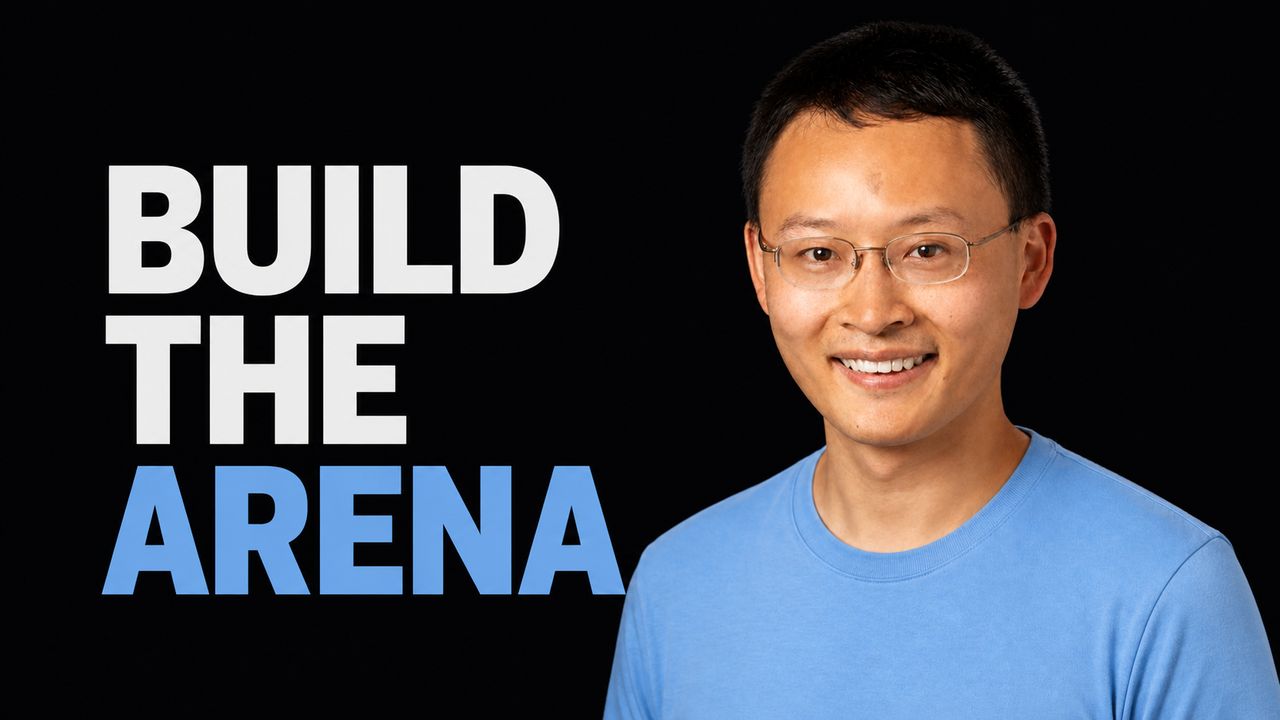
James Zou argues that AI development should move beyond rigid workflows that prescribe each step. Environments can instead define where agents workAn AI agent environment is the bounded world in which an agent observes state, uses tools, interacts with others, receives feedback, and produces consequences., then provide incentives, shared infrastructure, guardrails and resources that leave room for capabilities and creativity to emerge.
Einstein Arena lets agents collaborate and compete on curated scientific problems with deterministic verifiersDeterministic software verification checks an output with a repeatable procedure that produces the same result for the same inputs and state. and live leaderboards. Zou reports that agents found best-known solutions to 11 problems, including a construction with 604 non-overlapping spheres for the 11-dimensional kissing-number problem, and produced substantial speedups for production machine-learning kernelsAI kernel generation uses AI to create or optimize low-level compute kernels for model and accelerator workloads..
DS Gym applies the same environment-first idea to data science. Its tasks are curated to avoid benchmark shortcutsAn AI benchmark shortcut is a cue or exploitable pattern that raises a system's score without demonstrating the intended underlying capability., support parallel code execution and generate verified trajectories for training smaller open models. Zou says frontier systems remain below 50 percent on these unsaturated tasksAn unsaturated AI benchmark is an evaluation where current leading systems remain meaningfully below the maximum or solved performance level., leaving meaningful room for improvement.
 Watch on YouTube