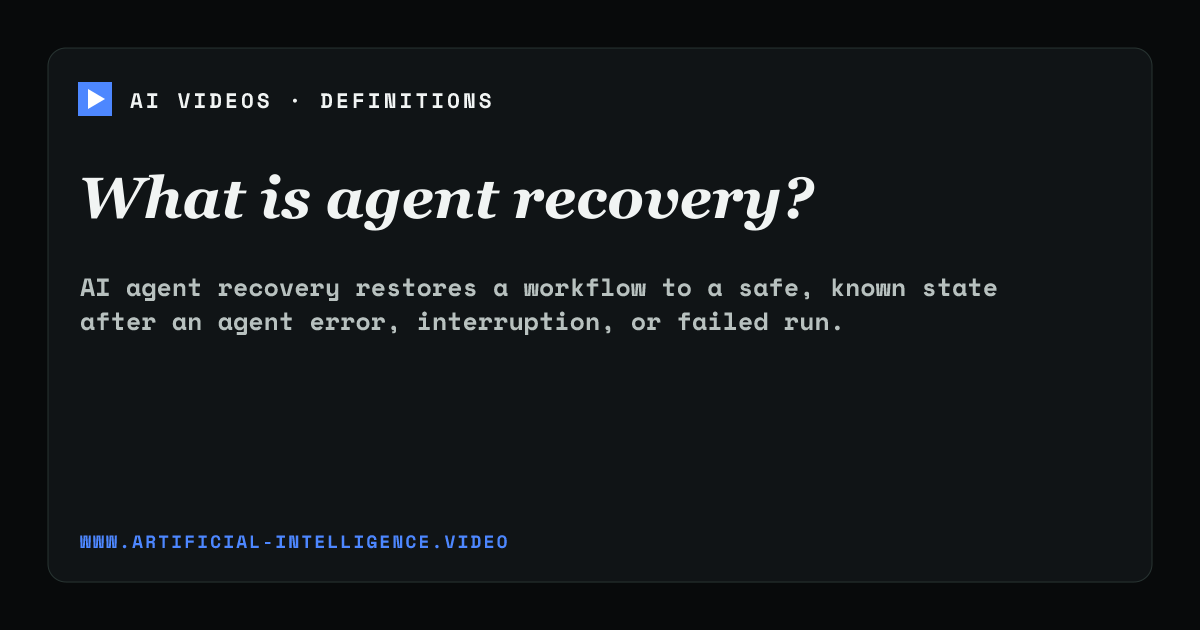
AI agent recovery defines how a system detects failure, preserves evidence, limits further effects, and resumes or reverses work safely. Recovery may involve retrying an idempotent step, rolling back a change, restoring state, or escalating to a person.
Recovery becomes more important as agents perform longer and more parallel workflows. A complete plan identifies safe checkpoints, ownership, retry limits, compensation actions, and the evidence needed to confirm that service has been restored.
ELI5
Agent recovery is the plan for returning an AI workflow to a safe known state after an error, interruption, or failed action. It includes detecting failure, stopping further damage, preserving evidence, and deciding whether to retry, reverse, restore, or ask a person.
For example, an interrupted data import can resume from a verified checkpoint instead of deleting the previous good data and starting blindly. A recovery plan needs clear ownership, retry limits, and proof that the service or state was restored correctly.
What can cause an AI agent run to fail?
Failures can come from incorrect planning, missing context, tool errors, permission problems, external service outages, ambiguous goals, or invalid intermediate results.
What makes agent recovery safe?
Safe recovery uses durable state, bounded retries, idempotent operations, checkpoints, audit evidence, compensation actions, and escalation when automation is uncertain.