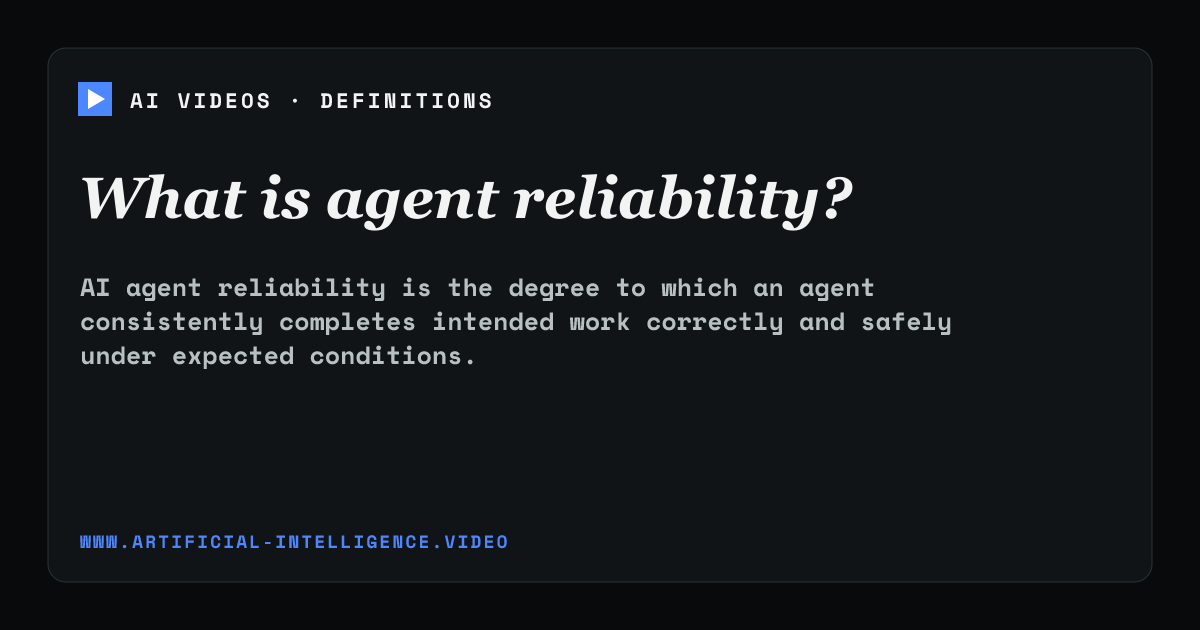
AI agent reliability covers task success, consistency, recovery, tool behavior, availability, and predictable handling of uncertainty or failure. A useful agent can still be unreliable when it succeeds often enough to impress but fails unpredictably on consequential steps.
Reliability is measured with representative tasks, repeated runs, long-horizon evaluations, error analysis, and production evidence. Monitoring, bounded permissions, checkpoints, deterministic verification, and human escalation can improve system reliability around a probabilistic model.
ELI5
Agent reliability describes how consistently an AI agent completes its intended work correctly and safely. An agent is not reliable just because it produces an impressive result once.
For example, an invoice agent that works correctly 99 times but sends the hundredth payment to the wrong account still has a serious reliability problem. Repeated tests, monitoring, validation, and human escalation help reveal and reduce such failures.
How is AI agent reliability measured?
Measure accepted task completion, error types, consistency, recovery, unsafe actions, latency, availability, and correction burden across representative runs.
Can an AI agent be useful but unreliable?
Yes. It may deliver valuable outcomes frequently while still requiring review because failures are unpredictable or costly.