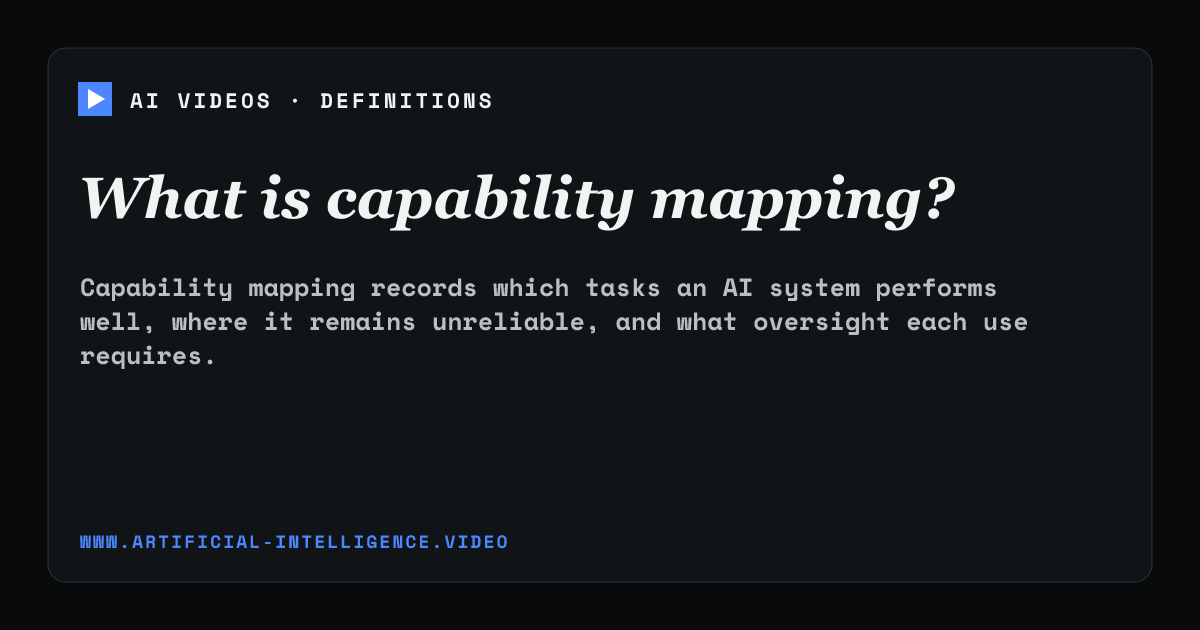
Capability mapping connects models and tools to representative tasks, conditions, quality thresholds, costs, and known failure modes. It helps a team choose where AI adds value instead of treating one broad benchmark as proof of suitability.
The map should change as models, prompts, tools, and workflows change. Reliable evidence includes repeated evaluations, real task outcomes, uncertainty, and the human supervision needed to reach an acceptable result.
ELI5
Capability mapping creates a practical guide to what an AI can and cannot do well. It connects real tasks with evidence about quality, reliability, cost, and how much human checking is needed.
For example, a team may find that one model reliably summarizes routine meetings but needs expert review for legal analysis. The map helps route each task appropriately and is updated after model or workflow changes.
What belongs in a capability map?
It can include tasks, models, conditions, quality thresholds, failures, cost, latency, uncertainty, tools, and required human oversight.
Why must capability maps be updated?
Model versions, prompts, tools, data, and operating conditions change what a system can do reliably.