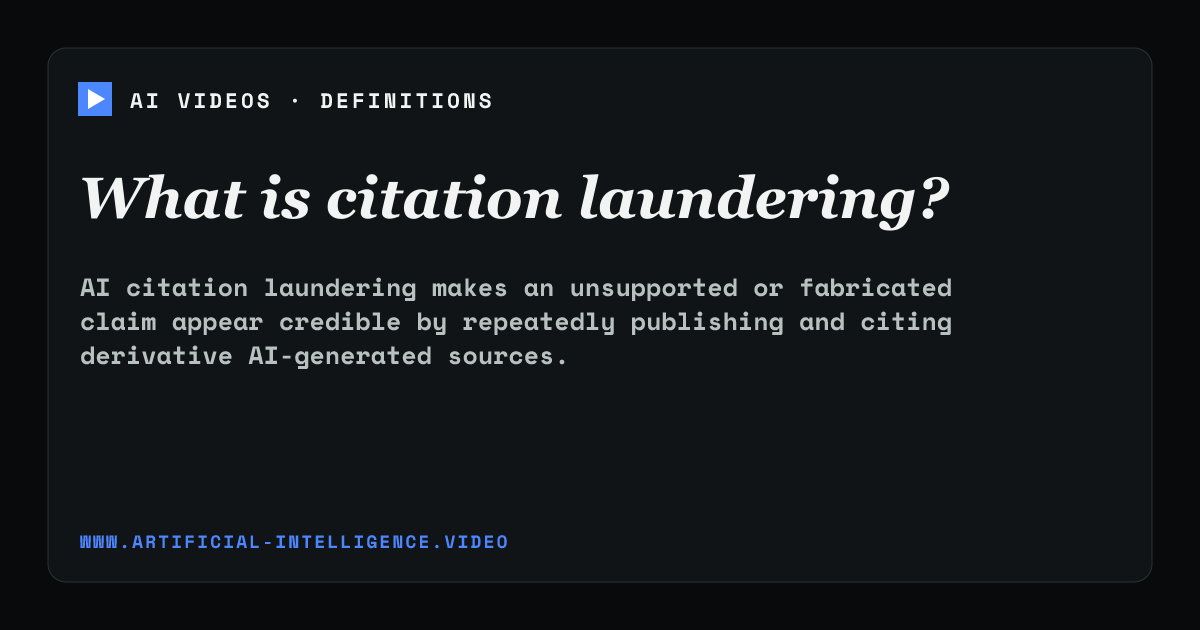
AI citation laundering occurs when generated content is placed online and later research systems cite that content as though it were independent evidence. Each derivative page can add formatting, links, or confident explanation while the chain still lacks a credible primary source.
The problem differs from a citation that points nowhere because a real page may exist. Detection requires following the evidence chain, checking whether sources are independent, identifying copied claims, and confirming that the earliest available source actually supports the conclusion.
ELI5
Citation laundering happens when an unsupported claim is copied into new pages and later cited as though those pages were independent evidence. Repetition and professional formatting can make a claim look stronger even though every version traces back to the same weak source.
For example, an AI-written article may invent a statistic, several sites may repeat it and a later research tool may cite those sites. Checking the earliest source and whether it actually supports the claim reveals that the apparent agreement is not real evidence.
How is AI citation laundering different from hallucination?
A laundered citation may point to a real page, but that page can be derivative or unsupported rather than credible evidence for the claim.
How can AI citation laundering be detected?
Open each citation, trace repeated wording and references backward, identify the primary source, and confirm that it supports the specific claim.