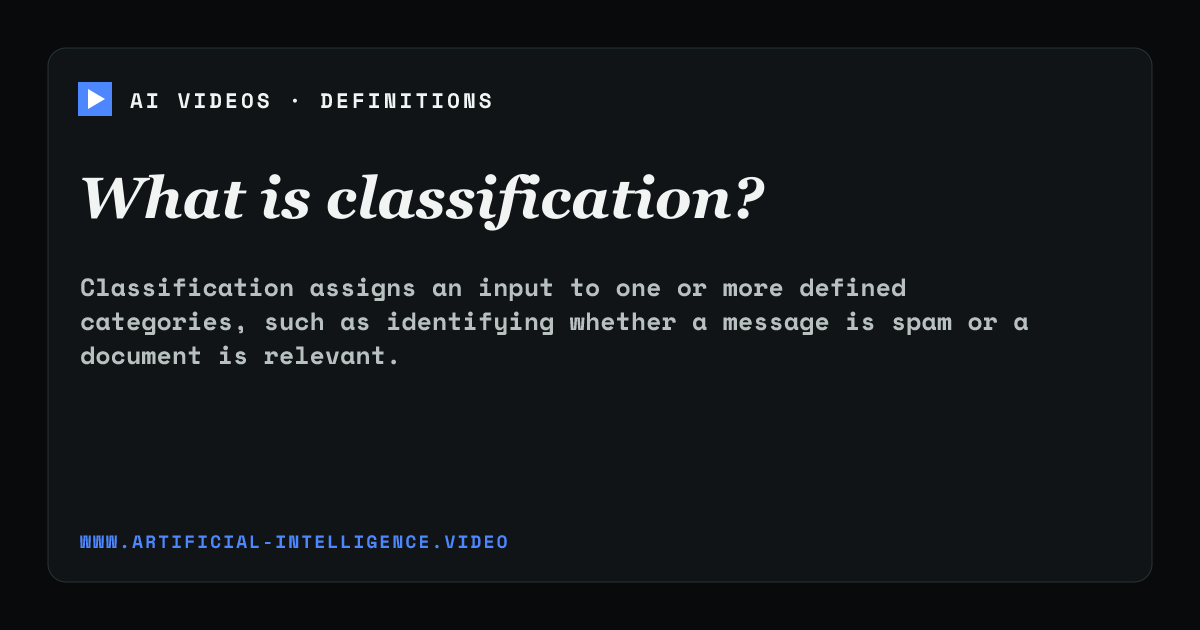
A classifier maps information such as text, images or structured records to labels. Its output may be a single category, several applicable categories or scores that support a later decision.
Useful classification requires well-defined labels and evaluation on representative data. Ambiguous cases, changing inputs and costly errors may require abstention or human verification rather than treating every predicted label as certain.
ELI5
Classification is sorting information into named groups. An AI system learns clues that help it decide which group an item belongs in.
For example, a support team could sort incoming messages into billing, delivery and technical questions. If a customer asks where a parcel is, the system should choose delivery, so the request reaches the appropriate team.
Can one input have several labels?
Yes. Multi-label classification permits several categories when the task and label definitions allow them.
Does a high model score guarantee the label is correct?
No. Scores must be evaluated and calibrated for the task, and unfamiliar or ambiguous inputs can still lead to incorrect predictions.