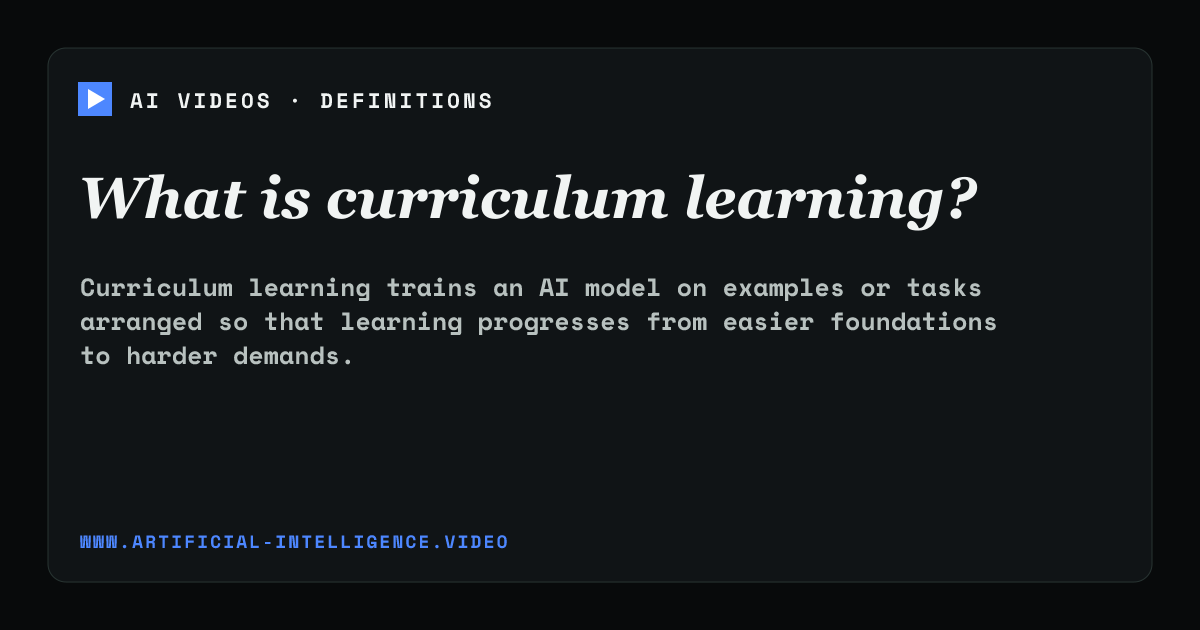
Curriculum learning controls the order or difficulty of training material instead of sampling every task in the same way from the beginning. A model may first learn simpler patterns and shorter tasks, then encounter harder, longer or more varied work as training progresses.
A well-designed curriculum can stabilize optimization and help the model build skills that support later challenges. It is not automatically better than shuffled training: the sequence, pace and definition of difficulty must match the model and objective, and results still need evaluation against an appropriate baseline.
ELI5
Curriculum learning trains an AI model with lessons arranged from easier foundations to harder tasks. The model builds useful basic skills before it faces more difficult examples.
For example, a language model might first learn short, clear reasoning problems and later work on longer problems with distracting details. The ordering is helpful only if experiments show it works better than ordinary shuffled training for the same goal.
Why begin AI training with simpler tasks?
Simpler tasks can establish useful representations and behaviors before harder examples demand several skills at once, which may make later learning more stable or efficient.
Is curriculum learning the same as fine-tuning?
No. Curriculum learning describes how training examples or tasks are ordered, while fine-tuning adapts a previously trained model to new data or objectives. The two methods can be combined.