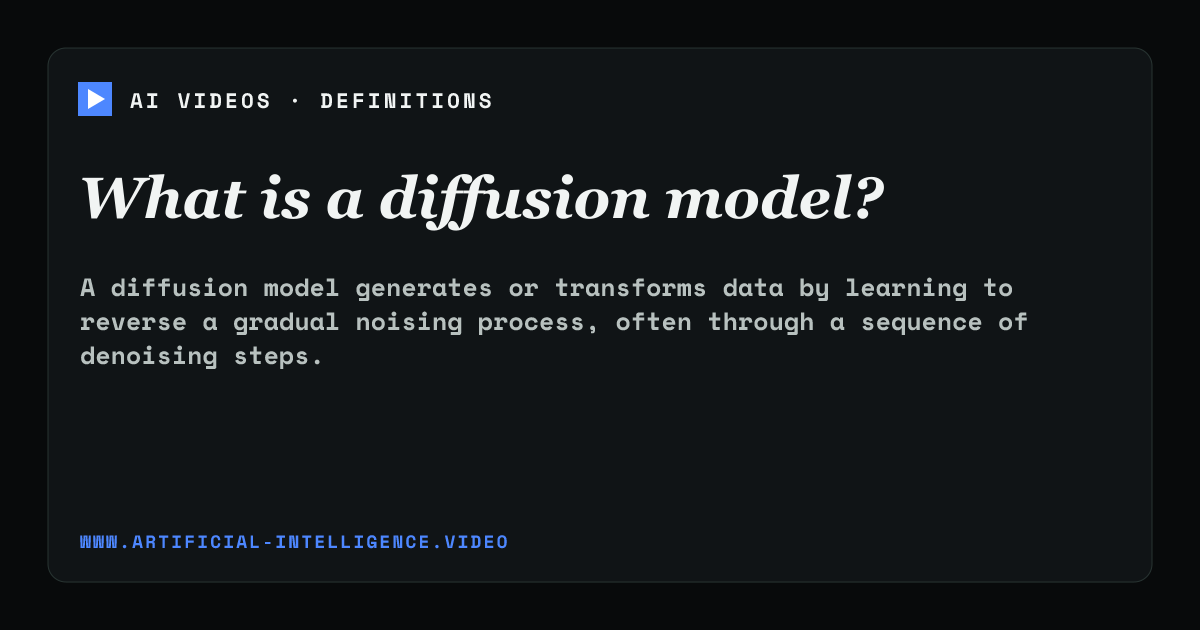
A diffusion model learns how to recover structured data from noise. During generation it begins with noise or a partially corrupted input and repeatedly predicts a cleaner state, producing images, video, audio, 3D representations or other outputs.
Traditional sampling can require many denoising steps, which adds latency. Research improves speed through better samplers, distillation, sparse computation or parallel generation blocks. Fewer steps can be much faster, but the method must preserve quality and temporal or spatial consistency.
ELI5
A diffusion model learns to turn random noise into structured data through a series of cleanup steps. It can generate images, video, audio or other outputs by repeatedly predicting a less noisy version.
For example, an image model can start with a screen of random pixels and gradually form a requested scene. Using fewer cleanup steps can make generation faster, but the shortcut still has to preserve detail and consistency.
Why do diffusion models use denoising steps?
The model is trained to reverse controlled corruption. Repeating that learned denoising operation gradually turns an initial noisy state into a coherent sample.
What can diffusion models generate?
They are widely used for images and video and can also generate audio, 3D assets, motion and other continuous data. The model architecture and training data determine the supported output.