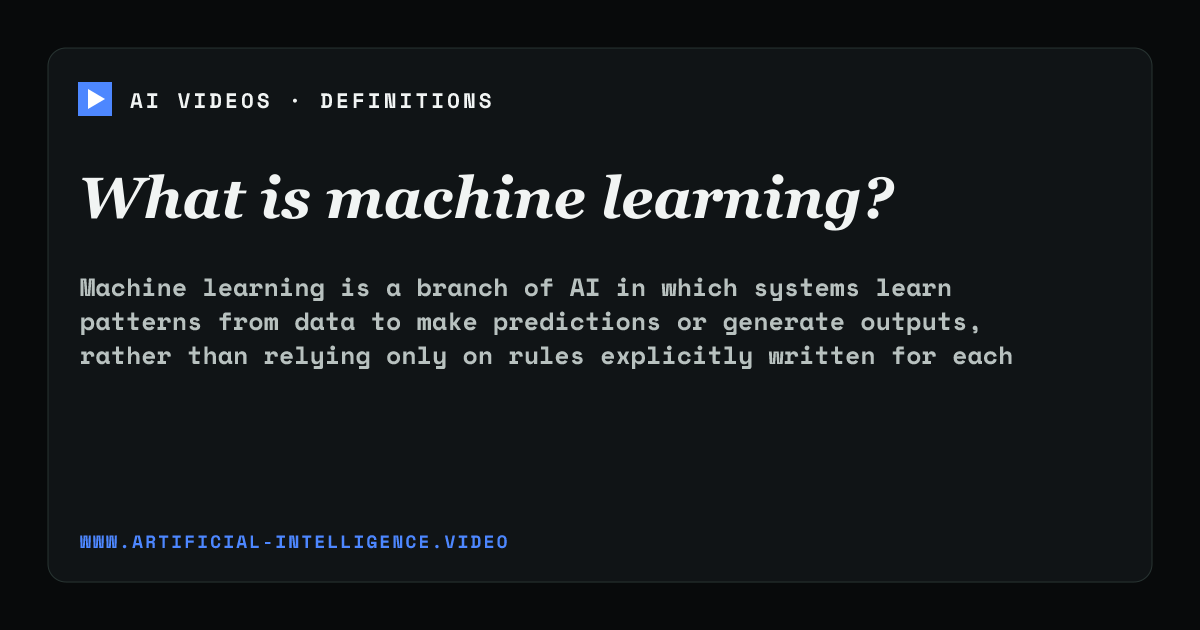
A machine-learning system is trained on examples. During training, an algorithm adjusts the model so its outputs better match an objective, such as predicting a measured value or identifying a category. The resulting model can then process new inputs without being given a separate rule for every possible case.
In weather forecasting, historical measurements can help a model learn relationships between atmospheric conditions and later weather. This differs from directly calculating every forecast through numerical approximations of physical equations, although learned and physics-based methods can also be combined.
Learning patterns does not guarantee reliable predictions in every situation. Results depend on the data, the training objective and how closely new situations resemble the conditions the model can handle. Rare events and changing conditions require particular attention during evaluation.
ELI5
Machine learning teaches a computer through examples. Instead of a person writing every rule, the computer adjusts how it works after seeing many cases.
For example, it could study records of temperature, wind and rain, then learn patterns that help predict tomorrow's conditions. It can still get the forecast wrong, especially when the weather is unlike the examples it learned from.
Is machine learning the same as AI?
No. Machine learning is one part of AI, focused on learning from data. AI also includes approaches that use explicitly written rules or search procedures.
Does a trained model automatically learn from every new input?
No. Many models use new inputs only to produce an output. Updating what they have learned requires a separate training or adaptation process.