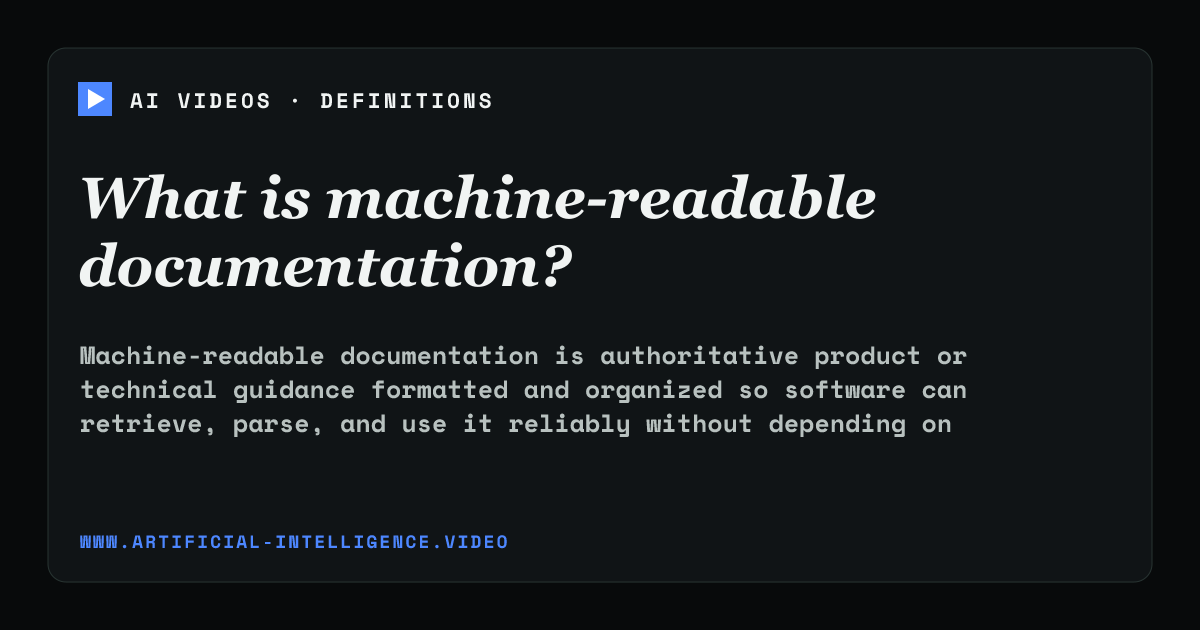
Machine-readable documentation uses predictable text, headings, links, identifiers, code blocks, and metadata. Formats such as Markdown reduce presentation noise, while indexes and stable URLs help an agent locate the smallest relevant document instead of loading an entire site into its context.
The documentation must remain useful to people and machines. It should preserve version, provenance, scope, and update information; avoid hiding essential facts in scripts or images; and distinguish examples from requirements. A structured format does not compensate for stale, ambiguous, or inaccurate content.
ELI5
Machine-readable documentation is written and organized so software can find and understand important instructions without guessing from a visual webpage. Clear headings, stable links, code blocks and structured fields help an AI tool retrieve the right section.
For example, a software library can publish a Markdown guide with separate installation, authentication and error sections. An AI coding agent can retrieve only the authentication section, while a person can read the same source normally.
Why do AI agents need machine-readable documentation?
It reduces brittle page parsing and gives agents a lower-cost, more predictable way to retrieve authoritative instructions and technical facts.
Does machine-readable documentation replace human documentation?
No. The best source remains clear for people while also providing stable structure and text that software can retrieve and interpret.