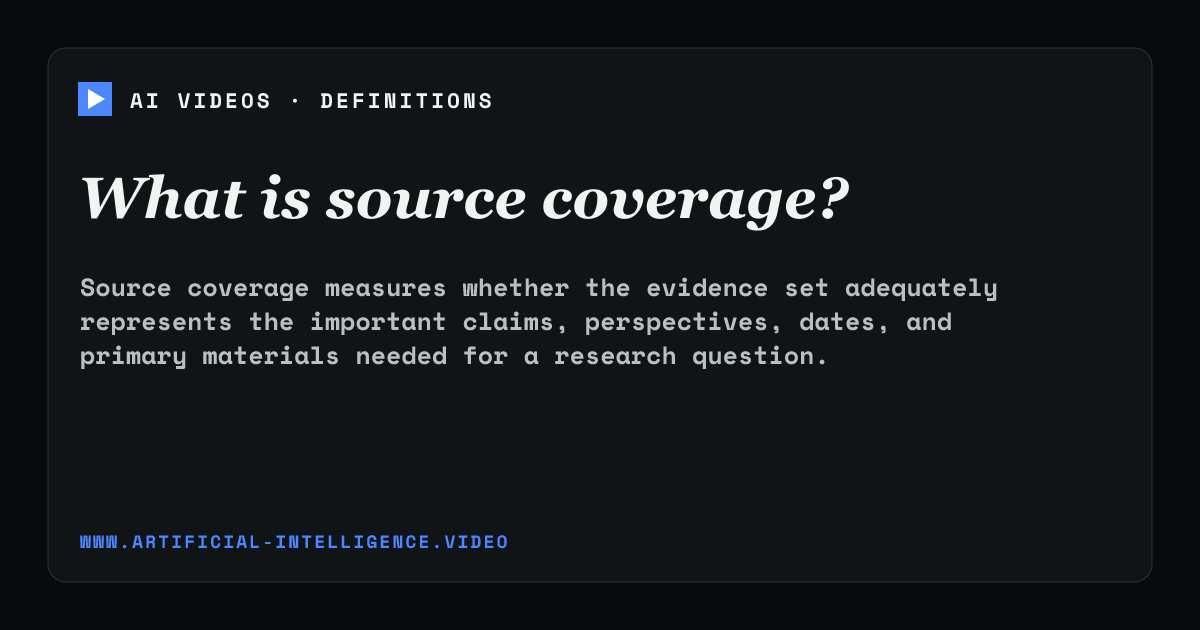
Coverage is about relevance and completeness, not raw source count. A review can check whether each material claim has support, primary evidence was sought, opposing findings were considered, important time periods are represented, and inaccessible sources are disclosed.
Perfect coverage is rarely possible. The workflow should state its search boundary, gaps, and confidence, then avoid treating an incomplete source set as evidence that no contrary material exists.
ELI5
Source coverage asks whether the research looked in enough of the right places to support its important conclusions. Ten weak articles repeating one announcement may provide less coverage than one primary report and one careful independent analysis.
For example, a verifier can flag a medical claim supported only by news summaries when the original study was never checked. The report should find the primary evidence or clearly state the gap.
Does more sources always mean better coverage?
No. Duplicated, derivative, irrelevant, or low-quality sources may add little. Coverage depends on whether the necessary evidence and perspectives are represented.
How should inaccessible sources be handled?
Record the access failure, avoid claiming verification from unseen material, seek credible alternatives, and disclose any resulting limitation.