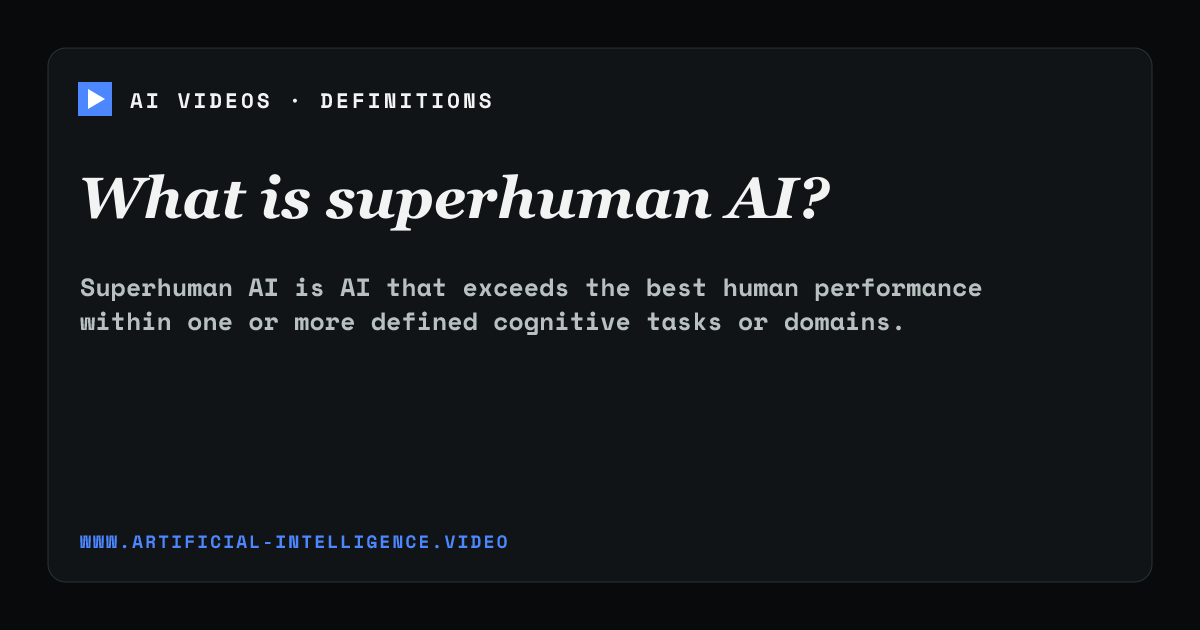
Superhuman AI is always relative to a task and comparison group. A model may surpass experts in a benchmark, game, coding task, or scientific subproblem while remaining unreliable, dependent on tools, or weaker than people in other forms of judgment and real-world adaptation.
Claims of superhuman performance need representative tasks, current human baselines, robust evaluation, and attention to cost and failure modes. Broader capability increases the importance of safety research because errors, misuse, or difficult-to-monitor strategies can also become more consequential.
ELI5
Superhuman AI performs better than the best people on a clearly defined task or group of tasks. The claim does not mean the system is better than humans at everything.
For example, an AI system may outperform expert players in one game while struggling with everyday judgment outside that environment. Strong claims need fair human comparisons, representative tests, and careful study of failures and costs.
Is superhuman AI the same as artificial general intelligence?
No. A system can be superhuman in a narrow domain without possessing broad, flexible competence across many kinds of work.
How should superhuman AI be evaluated?
Use strong human baselines, representative tasks, hidden tests, real-world evidence, failure analysis, and independent verification.