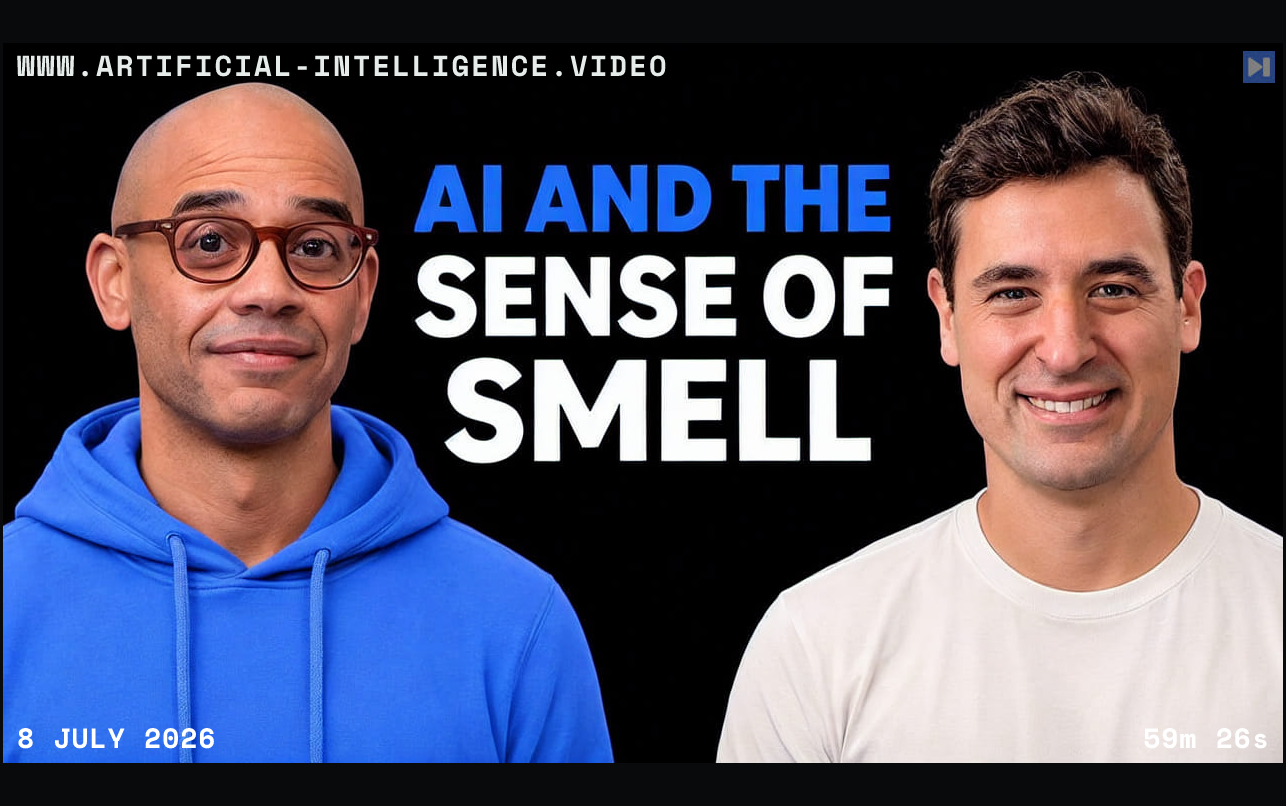
Osmo founder Alex Wiltschko joins Sam Charrington to discuss the challenge of representing smell in computers. He describes how graph neural networksA graph neural network is a model that learns from connected objects, using both their features and the relationships between them. and learned embeddingsAn embedding represents information as a list of numbers that an AI system can compare or process. can map molecular structures to perceived odorsAI-assisted scientific discovery uses AI to support hypothesis generation, experiment design, analysis, simulation, literature work, and interpretation while researchers retain responsibility..
Wiltschko explains the work of collecting sensory dataTraining data is the collection of examples and signals used to adjust an AI model's parameters so it learns useful patterns. and building models and infrastructure for fragrance applications. He distinguishes commercially available work from potential future uses such as detecting disease or assessing food freshness.
The discussion explores the difficulty of shrinking chemical sensors, building sustainable applications and measuring the relationship between scent and emotion. Wiltschko presents these possibilities and limitations as research and future work.
 Watch on YouTube