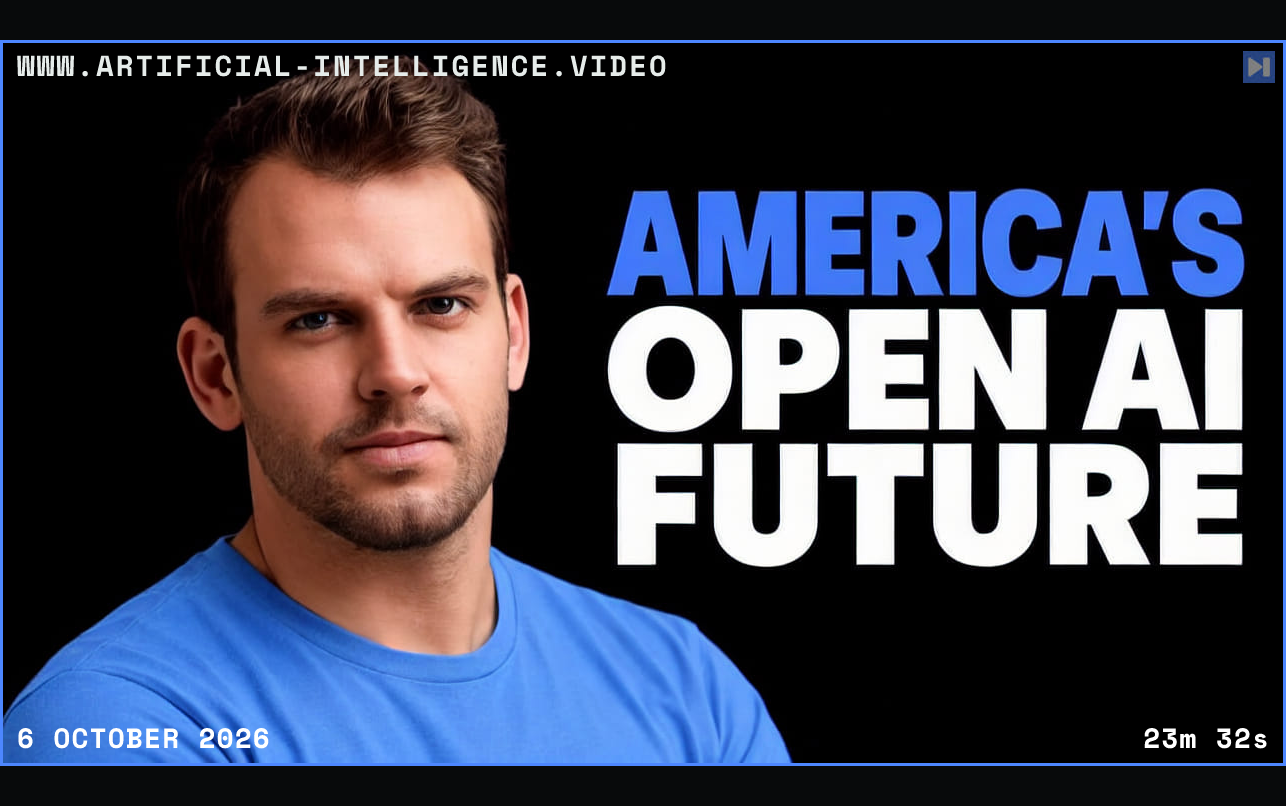
Nathaniel Whittemore separates three debates around open-weight AIAn open-weight model makes its trained parameter values available so others can run or adapt it under the release's licence.: enterprise strategy, safety and national security. Discussing reports of forthcoming American models, he treats their capabilities as unproven and argues that the broader shift in enterprise demand matters more than any individual release.
Nathaniel Whittemore explains why organizations may value access to model weights, customization and control over their data and infrastructureData sovereignty is the principle that data is governed by the laws and authority of the jurisdiction where it is stored or processed.. He contrasts those benefits with hosted frontier services and discusses how compute availabilityAI compute infrastructure is the hardware, facilities, networks, power, cooling, storage, and software used to train and run AI models., investment and the economics of inferenceInference cost is the expense of running a trained AI model to process inputs and produce outputs. affect the competitive landscape.
Nathaniel Whittemore also examines tensions between broad access and government oversightGovernance defines decision-making authority, rules and accountability within a system or organization.. The episode's preceding headlines cover community responses to data-center development, competing approaches to safety and experiments with open device software. The discussion presents reported developments and the host's interpretation, not independent validation of unreleased models or company performance claims.
 Watch on YouTube