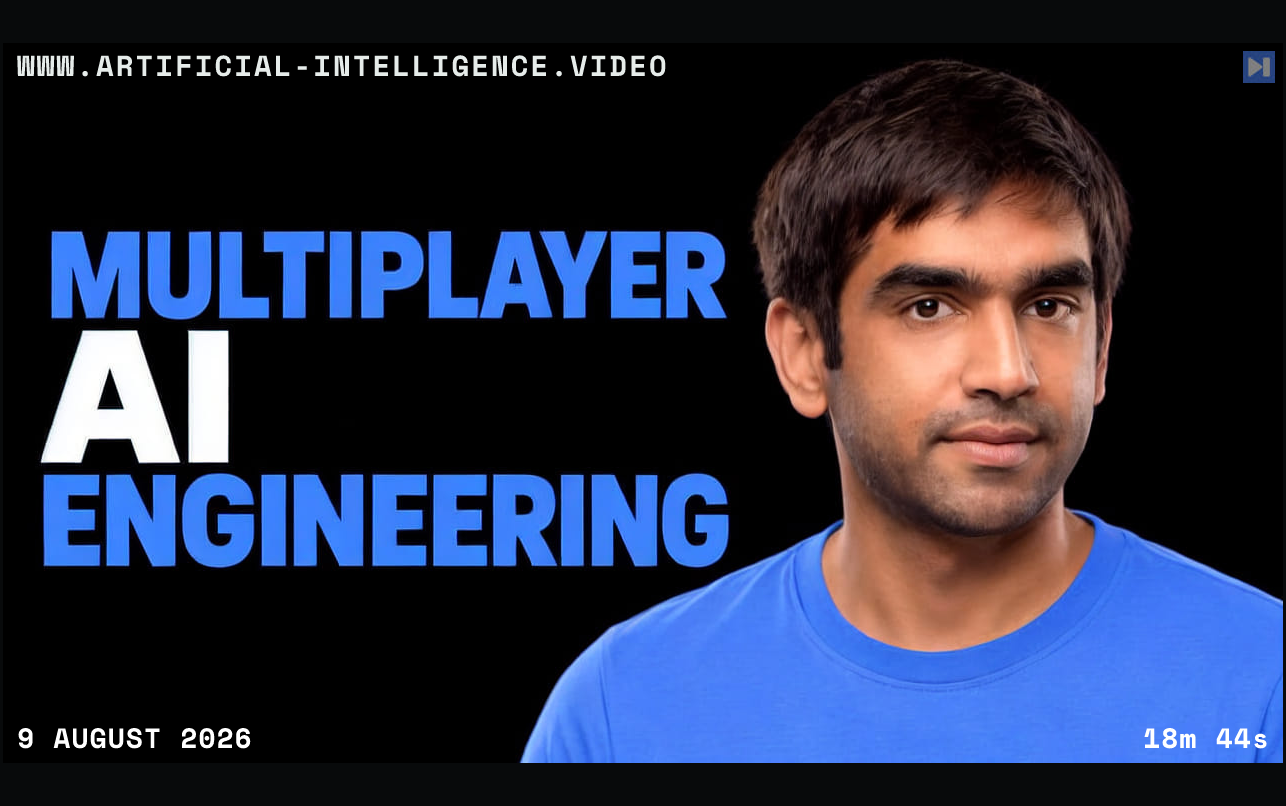
Arjun Singh frames agentic engineering as a collaboration problem involving both people and agents. His first recommendation is to remain model- and harness-agnostic so teams can switch tools as quality, availability, speed and cost change without disrupting their workflow.
Arjun Singh recommends keeping one agent session available across interfaces such as chat, engineering applications and code review. Shared contextContext engineering designs how relevant instructions, evidence, state and tool information are assembled for a model's task. and visible artifacts let technical and non-technical colleagues inspect progress, ask the agent why it made a choice and continue the same work without copying context between systems.
Arjun Singh demonstrates a meeting-driven workflow that turns customer conversations and other external signals into concrete prototypes or pull requests. He stresses that generated work should remain reviewable by people rather than being treated as complete simply because an agent produced it.
Arjun Singh argues for isolated cloud environmentsAn AI agent sandbox is an isolated execution environment that limits which files, processes, networks, credentials, and external systems an agent can access. with least-privilege credentialsLeast privilege gives a person or automated system only the access required for its current authorised work. and configurable network access. He closes by recommending benchmarksA benchmark is a defined test or collection of tasks used to compare a system's performance under specified conditions. built from representative pull requests on the team's own codebase, using measured quality, cost and time to choose or route modelsAI model routing sends each request to a model chosen for that request's complexity, cost, speed, privacy, or other requirements. while retaining human review.
 Watch on YouTube