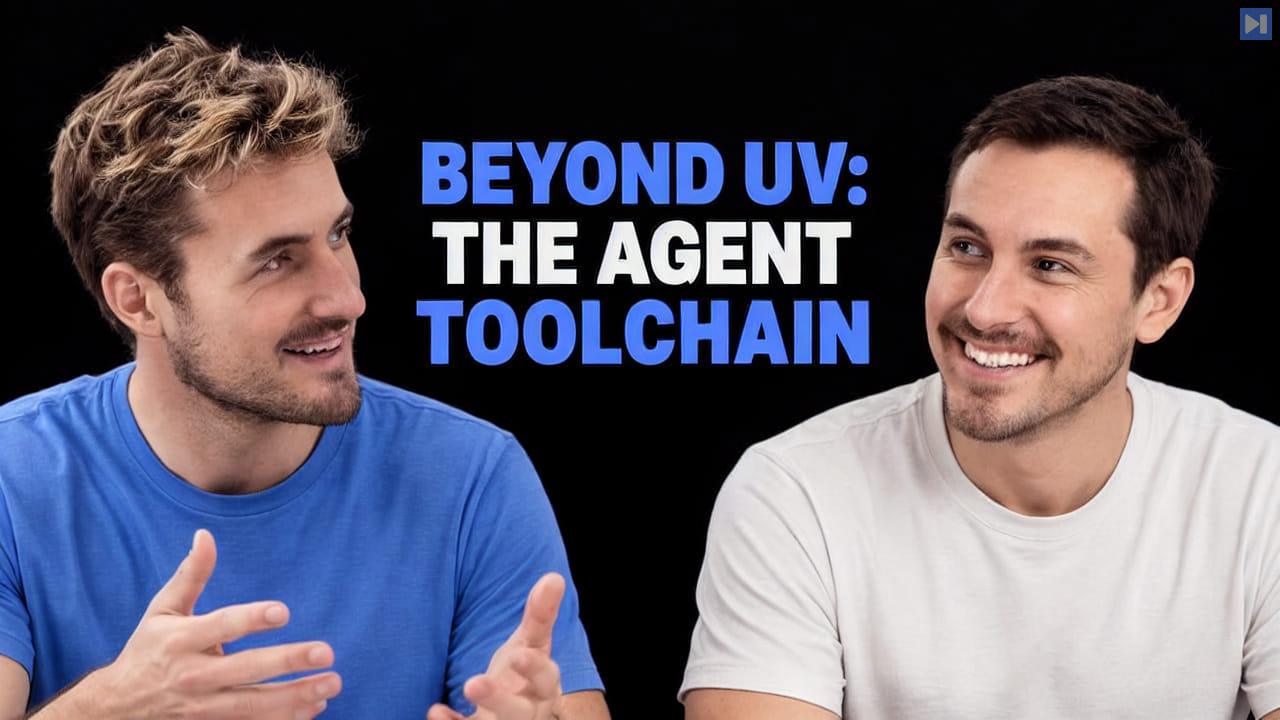
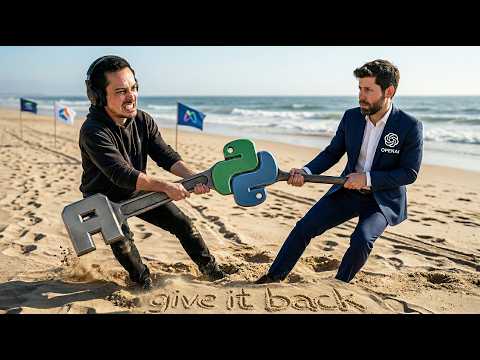
Pierce Freeman and Richard Diehl Martinez examine OpenAI's announced plan to acquire Astral, the company behind uv, Ruff and ty. They compare it with Anthropic's Bun acquisition and argue that low-level systems expertise may matter as much as owning a familiar developer tool. The proposed deal was still subject to closing conditions at the time of the episode.
Their central thesis concerns feedback loops: fast linting, formatting and type checkingEvaluation is the systematic assessment of a system's behaviour or results against explicit criteria. can help agents catch some problems before returning code. The hosts ask why OpenAI would acquire a team whose tools are already open source, suggesting development influence and tighter integration. A future closed version is speculation, not the announced policy.
GPT-5.4 mini and nano lead into Parameter Golf, a challenge to improve language-model performance within a small artifact and bounded training budgetAI compute infrastructure is the hardware, facilities, networks, power, cooling, storage, and software used to train and run AI models.. The hosts see compact experiments as a way to explore architecture and efficiency without the resource demands of frontier training. Throughput alone does not reveal a proprietary model's parameter count.
The discussion then considers local inference as a reusable building block rather than a headline feature. Avoiding network calls can support latency and data localityData privacy governs how personal, confidential, or sensitive information is collected, used, shared, retained, and protected in AI systems., though hardware, application behavior and task complexity still matter. The hosts connect constrained research with recruitment and possible local training opportunities without promising a particular laptop training time or universal quality transfer.
 Watch on YouTube