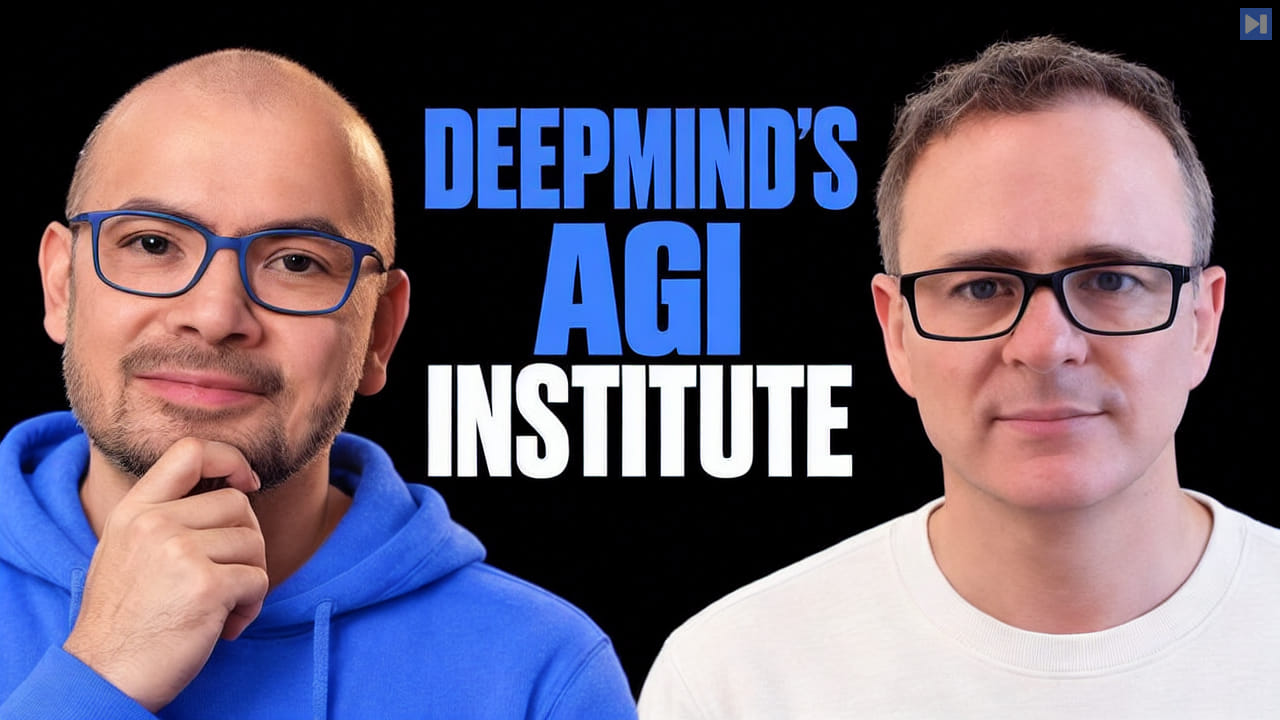
Zhengyao Jiang joins Tim Scarfe to discuss Weco's experiment in letting one research agent modify the harnessAn AI agent harness is the software framework that packages a model with tools, instructions, context management, execution controls, and user interaction. around another. Zhengyao Jiang reports that eight days of automated experimentation exceeded results from two years of manual engineering on held-out tasksAn evaluation set is a collection of examples kept for measuring an AI system rather than training it.. The model weights stayed fixed: the changes involved code, prompts, tools and the way experiments were organized.
Zhengyao Jiang describes evaluation splits, new benchmark families and safeguards against reward hackingReward hacking happens when an AI system exploits a scoring rule or proxy to earn a high reward without achieving the intended outcome.. One statistical detector itself stopped working during optimization, illustrating why a higher score is not enough to establish a reliable advance. He distinguishes repairing a broken evaluator from exploiting it and argues that tests must evolve alongside agent capabilities.
Zhengyao Jiang separates delegation and useful research output from a stronger claim: an optimizer becoming better at improving itselfRecursive self-improvement is the proposed process in which an AI system helps improve its own capabilities, then uses those improvements to support further advances.. He says this experiment did not establish that stronger level. Tim Scarfe and Zhengyao Jiang also discuss memoryAI agent memory is stored information that an agent can retrieve and use across steps, sessions, or changing contexts., search budgets, open-ended exploration and the continued importance of human-created abstractions and research directions.
 Watch on YouTube