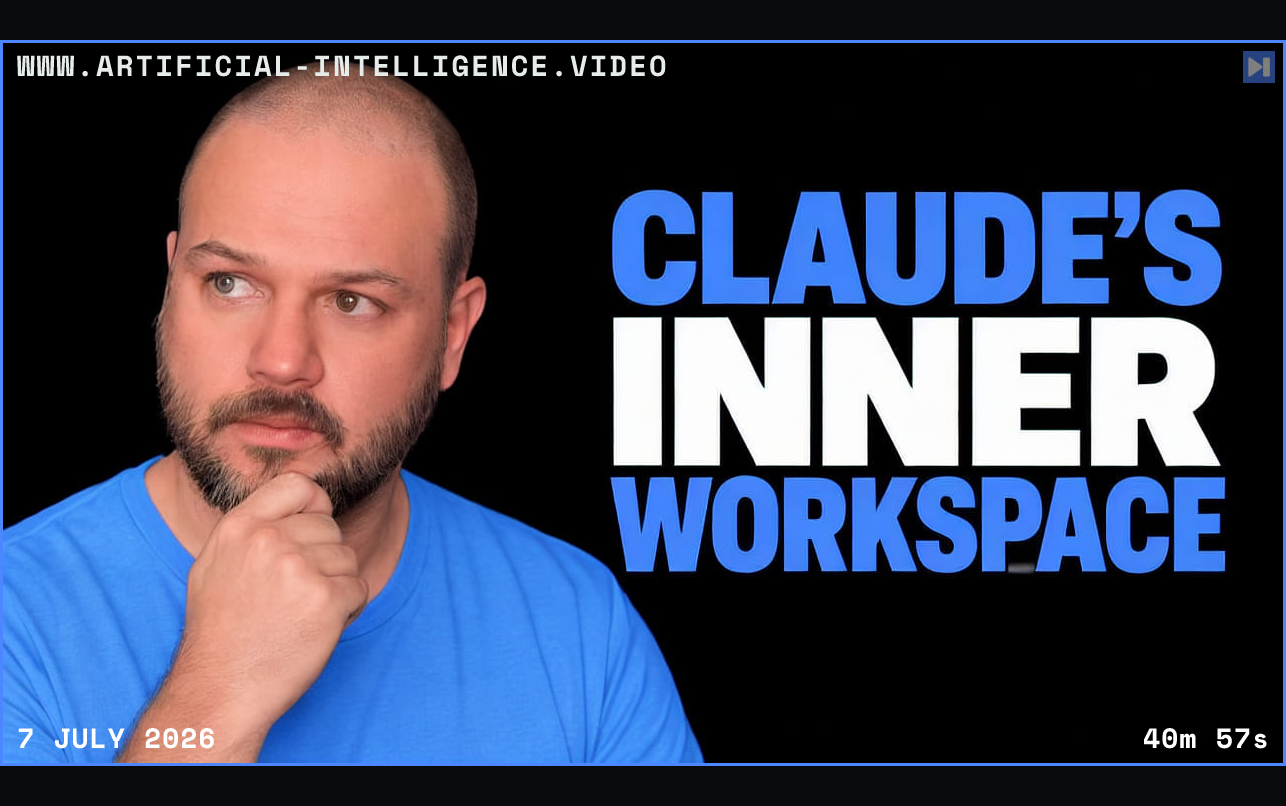
Wes Roth introduces Anthropic's reported global-workspace findings and explicitly warns against reading them as proof that Claude is conscious. He uses a spotlight analogy to distinguish information that becomes available for reasoning and reporting from the much broader activity inside a model.
Wes Roth describes examples in which internal concept representations influence answers without appearing in the written output or chain of thought. He also discusses changes to those representations and their effects on reasoning, presenting them as the research's reported experiments rather than experiments independently reproduced for this catalogue.
Wes Roth separates functional access to information from phenomenal consciousness, meaning subjective experience. He explores arguments that link those concepts as well as reasons for uncertainty, and relates the discussion to earlier work on functional emotions and introspection. Analogies with human cognition remain analogies, not evidence that a model feels joy, pain or anything else.
Wes Roth argues that surprising emergent behavior should motivate interpretability research and caution about overly confident conclusions. His final position is that the findings make model cognition worth studying more closely while leaving the consciousness question unresolved. The video therefore supports a nuanced research discussion, not its headline as an established factual claim.
 Watch on YouTube