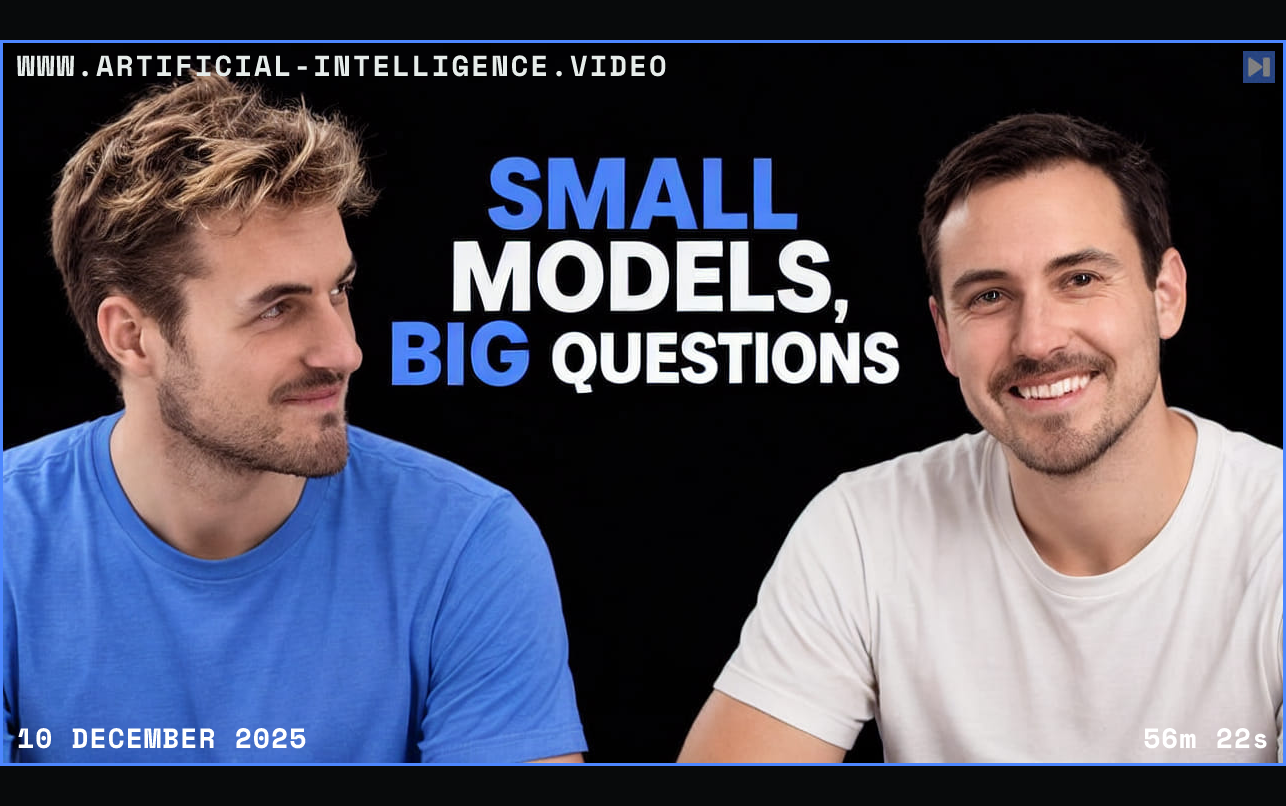
Pierce Freeman interviews co-host Richard Diehl Martinez about finishing his doctoral research. The conversation covers the thesis and examination experience, the value of sustained independent work and the freedom to pursue ideas whose outcome is uncertain.
Small language models offer a tractable setting for investigating how learning works under constrained resources. Martinez separates improving a model at a fixed size from obtaining gains by scaling, and connects smaller models to easier experimentation and potential deployment on limited hardware.
He describes an earlier probabilistic meta-learning direction that proved difficult, followed by a pivot toward language learning. Comparisons with human language acquisition motivate questions about generalizing from rare words and using grammatical context, without establishing that model learning and human cognition are equivalent.
Syntactic smoothing distributes training signal across syntactically similar tokens to reduce frequency bias. Martinez also discusses measuring learning trajectories and representation changes, rather than evaluating only a final model's loss or benchmark score.
Pico combines training and analysis tools for hypothesis-driven small-model experiments. The hosts consider the tradeoff between inspectable research code and general-purpose production libraries, then reflect on what a PhD can provide beyond a credential.
 Watch on YouTube