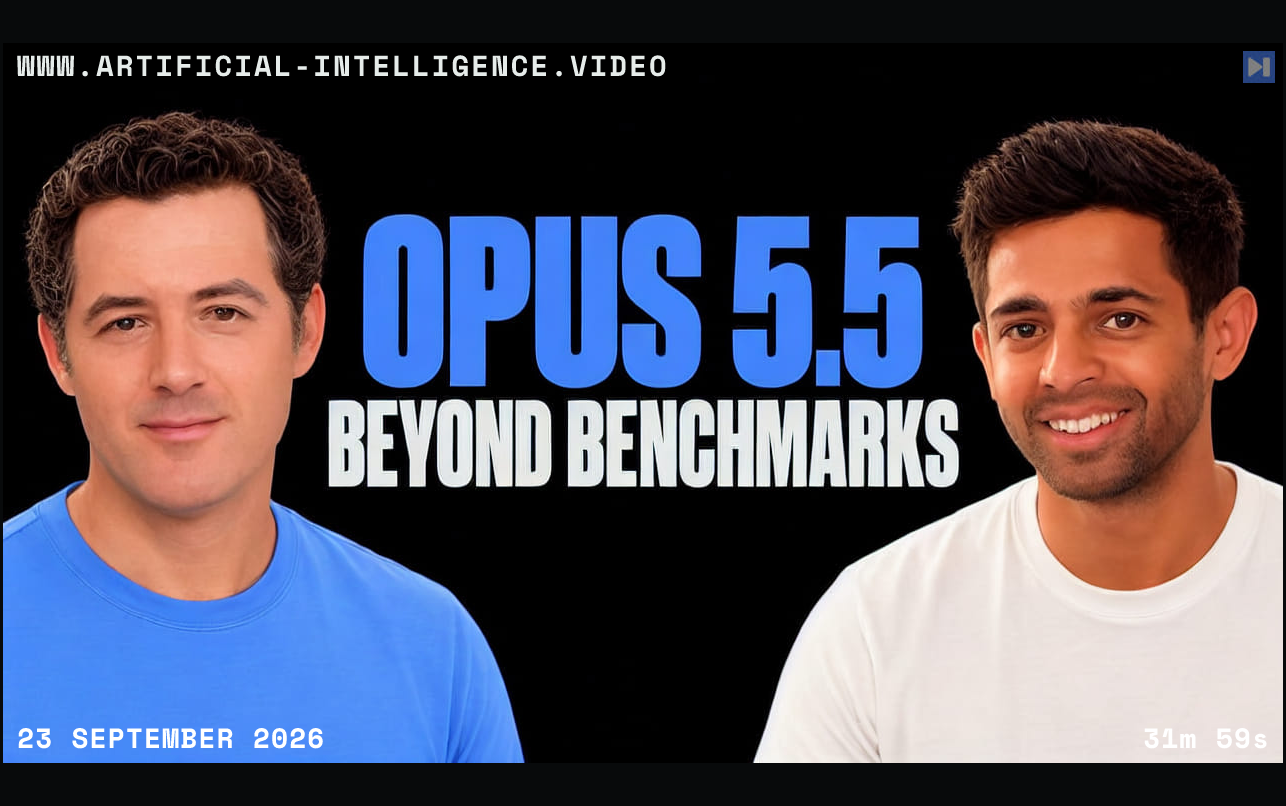
Matthew Berman examines Anthropic's Opus 5.5 release claims, separating lower token pricesToken pricing is the rate an AI provider charges for processing input tokens, generating output tokens, or reading cached tokens. from lower cost per completed taskCost per completed task measures the total AI, tool, infrastructure, retry, and repair expense for each verified useful outcome.. He discusses coding and knowledge-work benchmarksA benchmark is a defined test or collection of tasks used to compare a system's performance under specified conditions., faster responses and effort settings, while noting that stronger headline scores do not guarantee that every workflow benefits equally.
Matthew Berman interviews Thariq Shihipar about using different models for different stakesAI model routing sends each request to a model chosen for that request's complexity, cost, speed, privacy, or other requirements.. Thariq Shihipar describes choosing Opus for frequent coding work and reserving a more expensive model for planning or reviews where a mistake is costly. Model-assisted improvements emerge through many software changes rather than an instantaneous self-improvement loop.
Thariq Shihipar explains how agent harnessesAn AI agent harness is the software framework that packages a model with tools, instructions, context management, execution controls, and user interaction., prompts, plugins and evaluations must evolve alongside model capability. He also discusses research pacing, external evaluations and release safeguards. The conversation presents these as practical deployment tradeoffs, not proof that benchmark gains automatically translate into reliable autonomous systems.
 Watch on YouTube