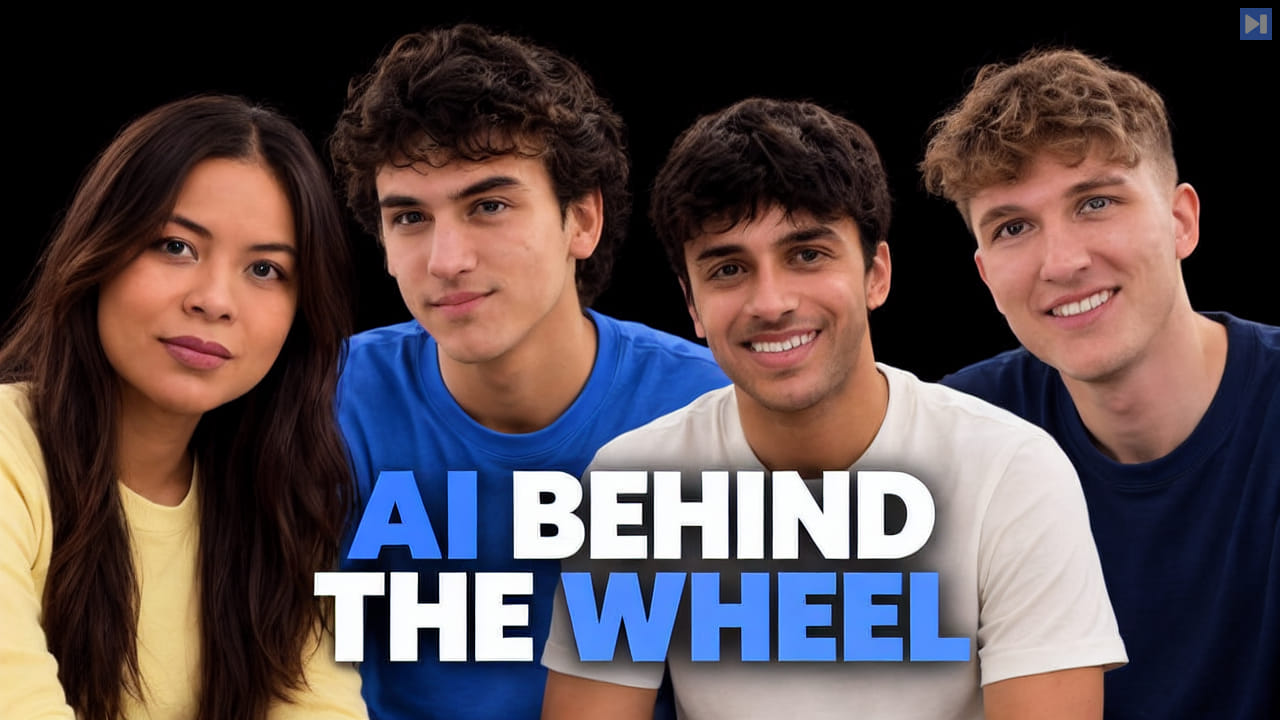
Sophia Dew interviews Simon Mahns, Aditya Ramabadran and Tobias Gessler about DrivingBench, a side project they developed after meeting at Axiom Math. The researchers gave general-purpose AI models tools to observe a real Toyota Corolla and control it through a low-speed cone course. The experiment tests perception, planning and physical control rather than proving that a chatbot is ready for ordinary road driving.
Simon Mahns, Aditya Ramabadran and Tobias Gessler report that GPT-6 Astra completed their course while other tested models struggled. They describe different driving behaviors and some improvement when models retained context across attempts. The team also discusses how task framing affected refusals, illustrating why successful execution and the reliability of safety boundaries must be evaluated separately.
Simon Mahns, Aditya Ramabadran and Tobias Gessler emphasize latency and the gap between describing the correct action and executing it. A car can keep moving while a model reasons, so delayed observations and command replacement change the control problem. The researchers call for more rigorous physical-world benchmarks and discuss combining general reasoning with specialized control systems; their forecasts remain proposals rather than demonstrated driving safety.
 Watch on YouTube