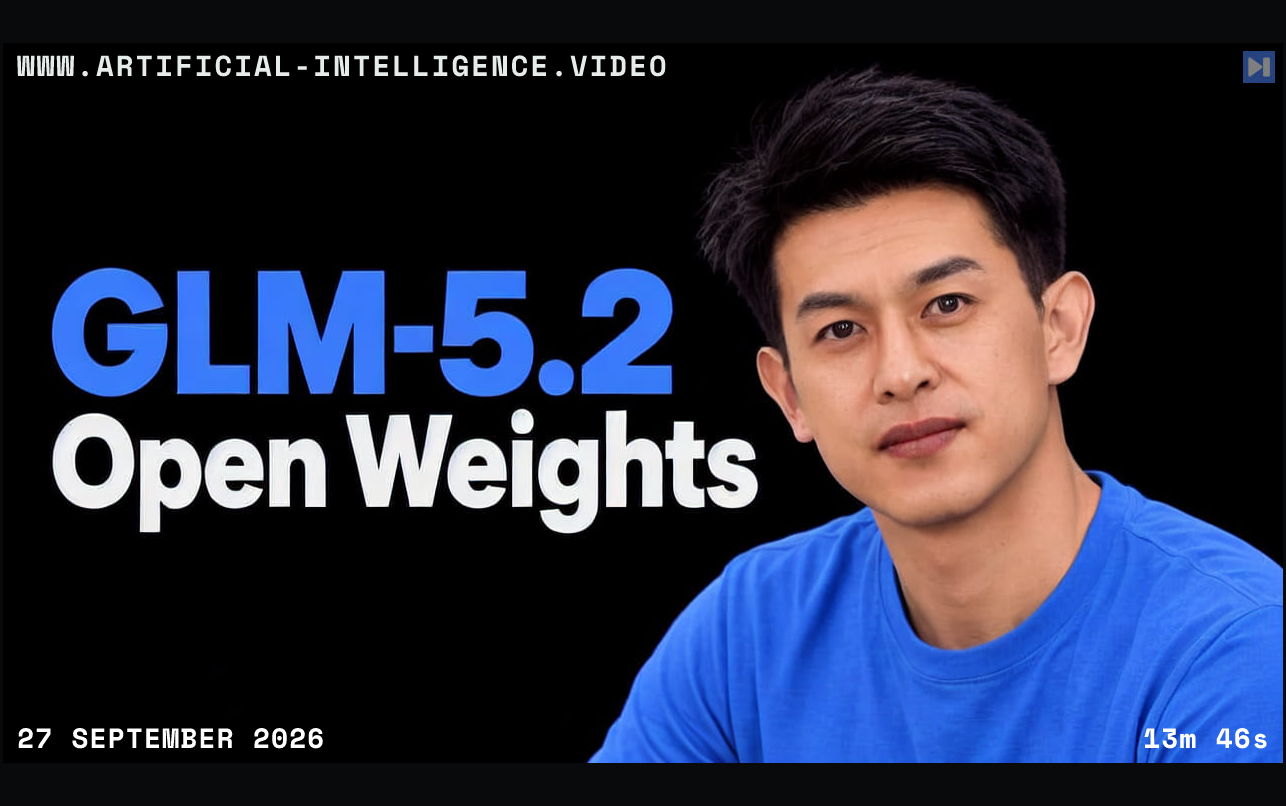
Zixuan Li presents GLM-5.2 and argues that AI intelligence should encompass reasoning, coding and agentic tasks beyond mathematical test scores. He reports improved performance on difficult, long-running tasks and describes a higher thinking budget, token-efficiency considerations and broader training for general conversation and other work.
Zixuan Li explains three reasons for opening model weightsAn open-weight model makes its trained parameter values available so others can run or adapt it under the release's licence.: giving users deployment control, enabling domain-specific fine-tuningFine-tuning adapts a pretrained model by updating its parameters on examples chosen for a particular task or subject. and allowing developers to inspect architecture and training methods. He discusses on-premise use and adaptations for fields such as legal work, finance and security as motivations for an open-weight ecosystem.
Zixuan Li also describes a coding harnessAn AI agent harness is the software framework that packages a model with tools, instructions, context management, execution controls, and user interaction. built for GLM-5.2 that can connect to other models using the user's own API keys. The keynote's performance comparisons and capability assessmentsEvaluation is the systematic assessment of a system's behaviour or results against explicit criteria. are presented as his reported results, with no independent validation supplied in the transcript.
 Watch on YouTube