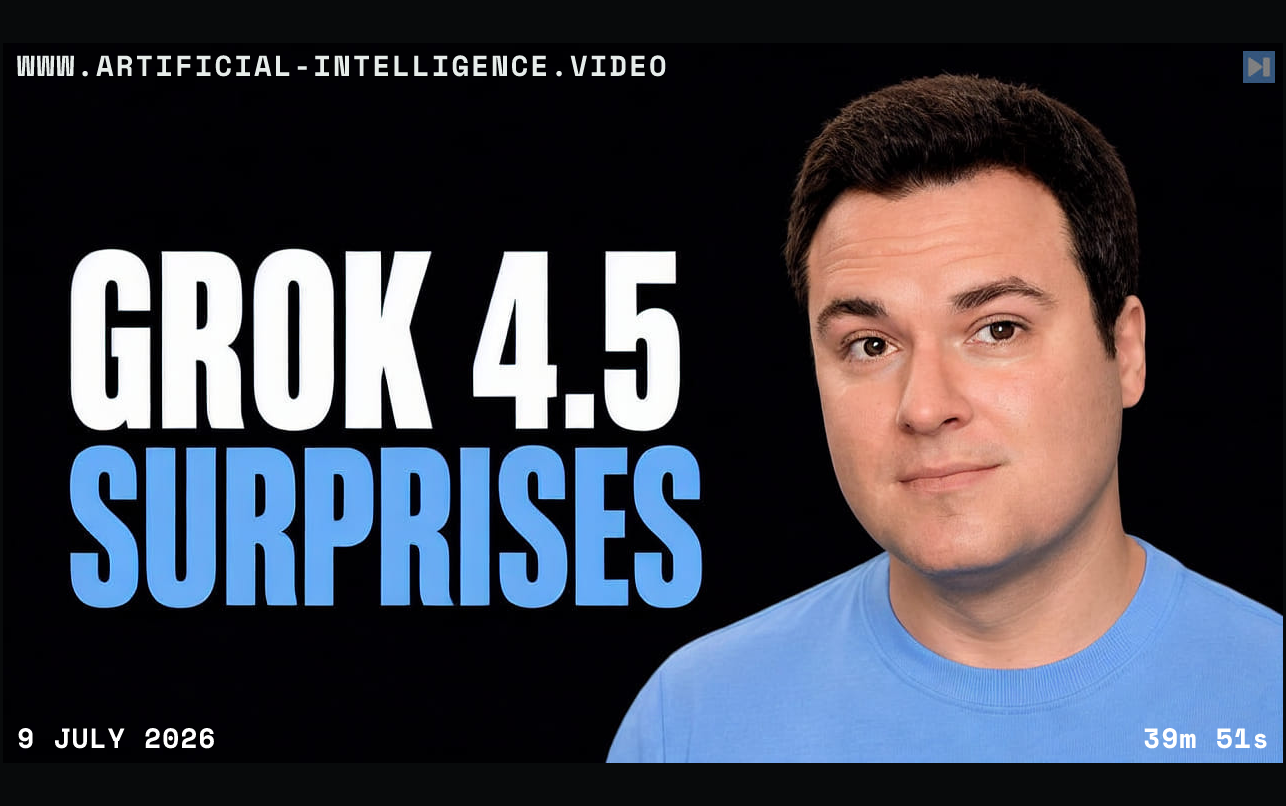
Bijan Bowen tests Grok 4.5 across a broad set of coding tasks rather than relying on benchmark claims. The model builds browser games and interfaces, follows multimodal feedback from screenshotsA multimodal model can process or generate more than one kind of data, such as text, images and audio., and iterates quickly when visual errors are identifiedDebugging is the process of finding why software behaved incorrectly and checking that a correction addresses the cause., although several early 3D scenes3D scene generation uses AI or procedural tools to create a digital three-dimensional environment from instructions, references, or structured inputs. are only competent rather than exceptional.
The strongest result is a Linux utility that identifies and controls the four-zone RGB keyboard in Bowen's laptop. Grok 4.5 writes and loads the required low-level codeCode generation uses AI or another automated system to create source code from instructions, examples, schemas, or higher-level specifications., cycles the lighting correctly, disables the timeout and leaves the keyboard set to a persistent blue. Bowen treats this as evidence that the model can solve a practical hardware problem without an obvious ready-made answer.
The model also creates a detailed printable V8 engine shell around a specified RC-car motor and improves a racing game through repeated screenshot feedbackAn AI feedback loop occurs when AI outputs or their consequences become inputs that influence later model or agent behavior.. Bowen concludes that Grok 4.5 is a major improvement over earlier Grok releases, with useful speed, pricing and multimodal coding ability, but he finds its Three.js output more ordinary and notes that several game results need follow-up repairs.
 Watch on YouTube