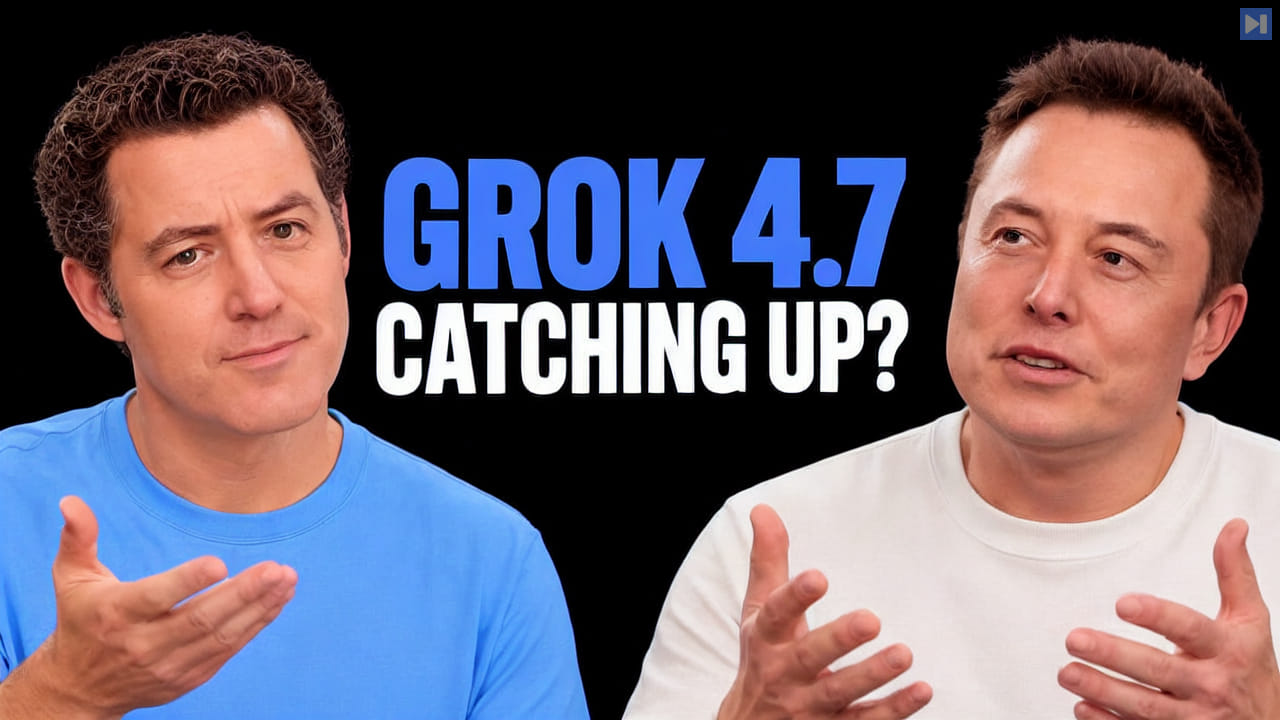
Alex Finn compares Grok 4.6 with other frontier models across code search, debugging, interface recreation and small interactive simulations. In his test set, Grok completed the work faster and at lower cost overallCost per completed task measures the total AI, tool, infrastructure, retry, and repair expense for each verified useful outcome., and it found all of the seeded bugs while performing especially well on the tool-heavy file scavenger task.
The visual results were not uniformly reliable. Grok produced attractive simulations and interface recreations, but several physics interactions were unstable, and the comparison remained a creator-designed test rather than an independent benchmarkEvaluation is the systematic assessment of a system's behaviour or results against explicit criteria.. Its strongest case was therefore value and practical coding performance, not an across-the-board quality win.
Alex Finn identifies the surrounding agent harnessAn AI agent harness is the software framework that packages a model with tools, instructions, context management, execution controls, and user interaction. as the main limitation. Cursor supports coding well, but does not yet combine coding, browser use, computer control, voice and mobile access as smoothly as the most complete general-purpose desktop systems. Grok 4.6 is most compelling for coding-focused users who prioritize speed and cost, while broader knowledge-work users may still need other tools.
 Watch on YouTube