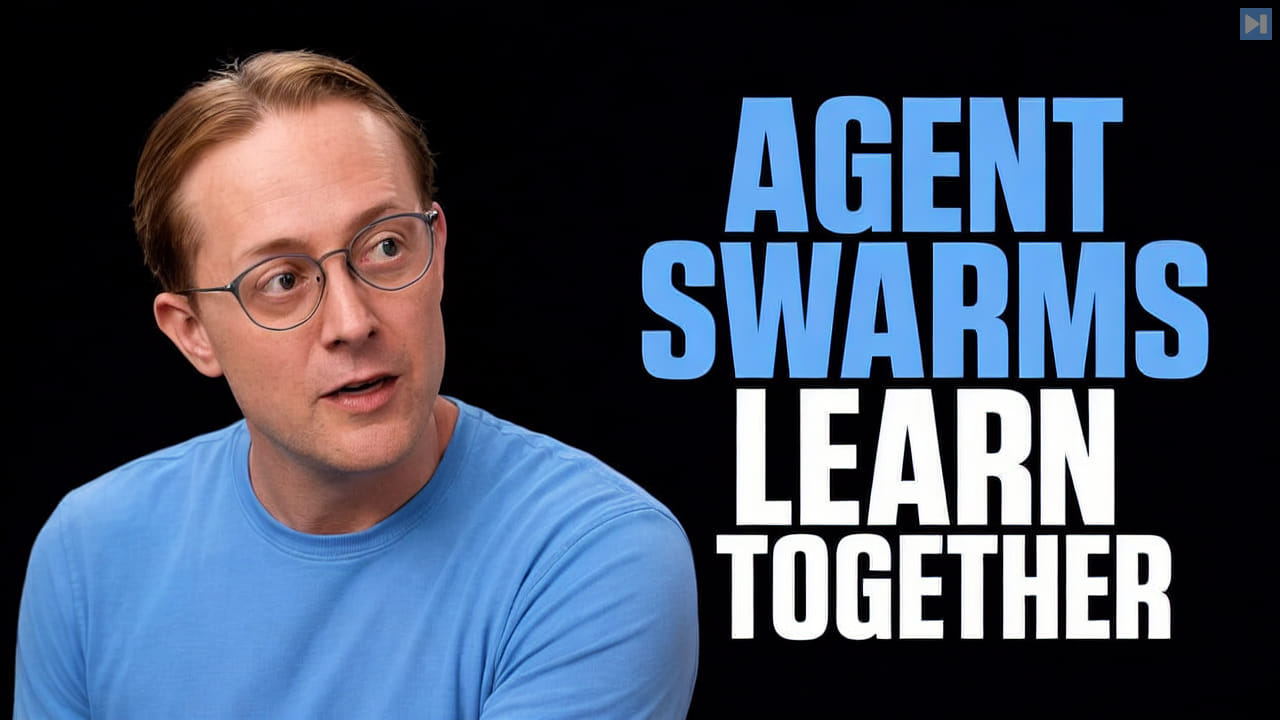
Bradley distinguishes continual learning stored inside model weights from explicit learning stored in shared memory, tools and institutional knowledge. Current agents mostly rely on the second form, which lets a group improve its behavior without retraining every underlying model.
He describes several swarm structures: systems with one leader and many agents, organizations serving multiple principals, and networks that combine models from different providers. Specialized agents can trade tasks and knowledge, allowing a collective to solve problems that no single general model handles as efficiently.
The organizational effect could be as important as the technical one. Companies may become orchestrators of agent labor, while marketplaces emerge for capabilities, datasets and learned procedures. Bradley warns that the coordination layer may accumulate unusual power because it controls how knowledge is priced, routed and reused.
The discussion extends the same logic to automated factories and self-replicating systems. Software agents can spread and improve quickly, but physical replication adds manufacturing and safety constraints. Bradley treats both domains as governance problems: powerful collectives need clear principals, limits and accountability before their coordination becomes difficult to reverse.
 Watch on YouTube