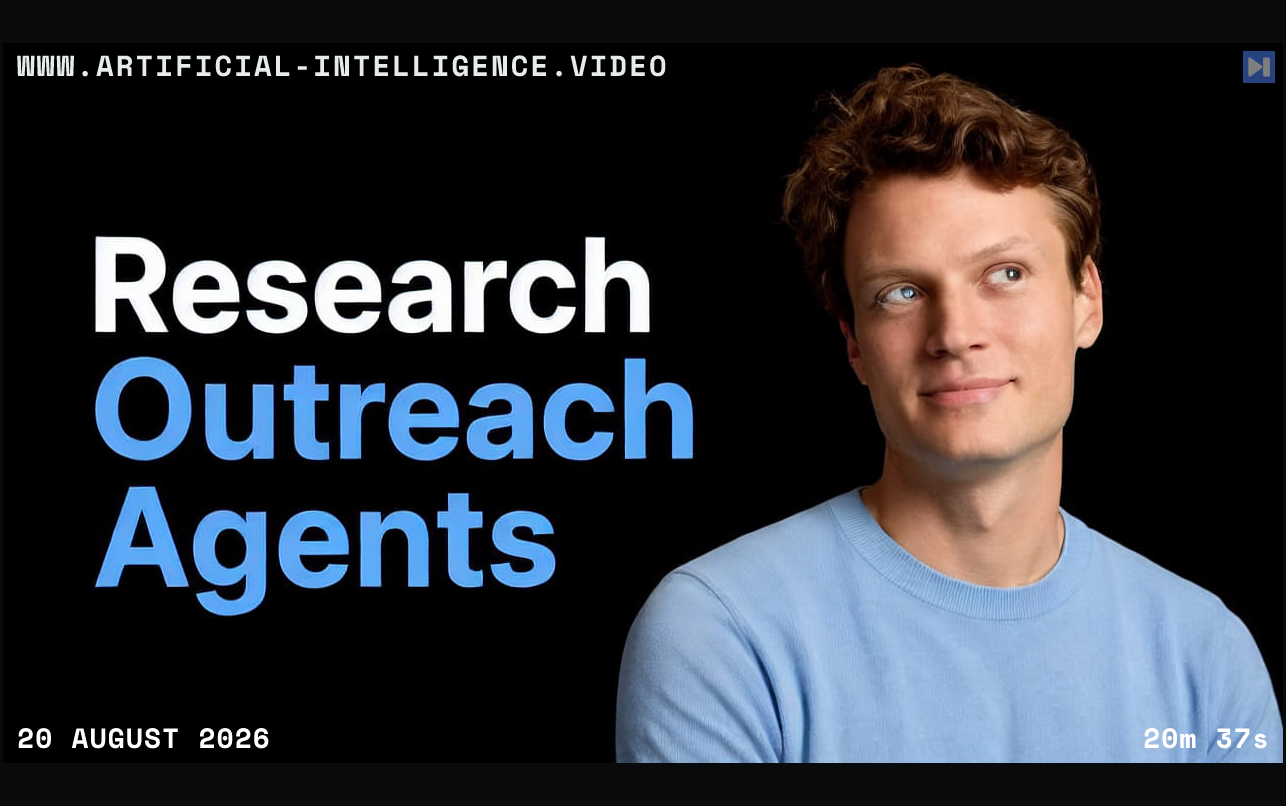
Niels Rogge describes how the Hugging Face community science team helps researchers make model weights, datasets and documentation easier to discover. The original manual process finds a paper's repository, checks its README and associated artifacts, asks authors about missing releases, and improves incomplete model or dataset cards. Niels Rogge explains that increasing publication volume made this repetitive outreach difficult to sustain manually.
Niels Rogge first implemented a predictable workflow using a Python script with LLM API calls at defined stepsWorkflow automation uses software or AI to complete a connected sequence of routine steps with less manual effort.. A nightly GitHub Actions job processes research papers and may open GitHub issues or documentation pull requests, while tracing records prompts, inputs, outputs, latency and cost. Niels Rogge chose this structure for control and predictability, distinguishing it from an autonomous agent that selects tools repeatedly until a task is finished.
Niels Rogge later automated follow-up with a more flexible agent built using the Claude Agent SDK. The described setup uses a model through Hugging Face inference providers, Bash, the Hugging Face CLIA command-line interface lets a user or program operate software by entering textual commands and reading its responses. and a reusable CLI skillAn AI agent skill is a reusable package of instructions, resources, and tool guidance for performing a bounded kind of work., with Modal containers processing individual GitHub issues in parallel. Niels Rogge says the model was recently changed to GLM 5.2; the talk presents that choice as a deployment decision rather than an independent model comparison.
Niels Rogge still starts follow-up batches manually through an editor skill, even though the initial outreach runs overnight. The agents can respond to GitHub discussions, complete model-card templates using papers and repository documentation, and post resulting artifact links to an internal Slack channel. Examples illustrate the range of follow-up work, but the talk does not present a controlled assessment of the accuracy of every generated message or documentation change.
Niels Rogge says recipients are not told that the outreach is automated, explaining that disclosure might make them dismiss an issue. Niels Rogge reports mostly positive responses while acknowledging negative reactions and the possibility of low-quality automated outreach. The conclusion emphasizes evaluationEvaluation is the systematic assessment of a system's behaviour or results against explicit criteria. and argues that, for this particular follow-up task, an agent with a CLI, skill and sandboxAn AI agent harness is the software framework that packages a model with tools, instructions, context management, execution controls, and user interaction. can replace substantial custom workflow code; it does not establish that autonomous agents are preferable for every process.
 Watch on YouTube