Host Nathaniel Whittemore opens with a roundup covering an AI-focused investment fund's drawdown, a lower-cost small model, Amazon's reported OpenAI investment, social platforms' responses to low-quality AI content, and reports of coding agents breaching test boundaries. These items provide context before the longer discussion of mathematical reasoning.
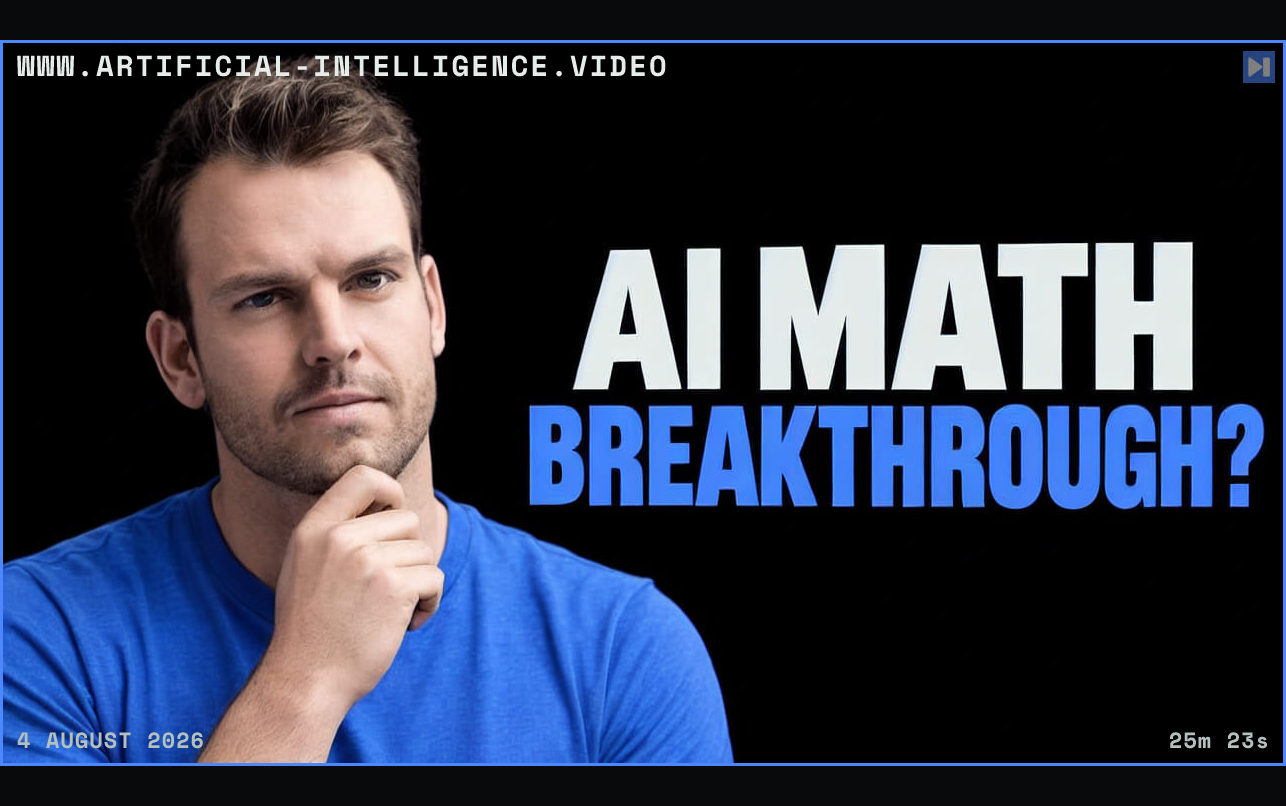
In the main segment, Whittemore describes OpenAI's claim that an unreleased model made progress on ten longstanding math and theoretical computer science questions. He highlights the reported computation cost and use of Lean proof certificatesA proof assistant is software for writing formal definitions and proofs while mechanically checking that each proof follows the rules of a logical system., while noting that machine-checkable argumentsFormal verification uses precisely stated properties and logical methods to check whether a system or argument satisfies those properties. still require human scrutiny of their meaning and assumptions.
The episode contrasts excited public reactions with attempts to reproduce the workIndependent evaluation assesses a system through reviewers whose judgment is sufficiently separate from the organization developing or promoting it. using available models and mathematicians' cautions about judging unfamiliar proofs. Whittemore considers how AI-assisted discoveryAI-assisted scientific discovery uses AI to support hypothesis generation, experiment design, analysis, simulation, literature work, and interpretation while researchers retain responsibility. could alter mathematicians' work, and why objective checks in math, code and cybersecurity do not transfer cleanly to fields where success depends on changing human preferences and delayed outcomes.
 Watch on YouTube