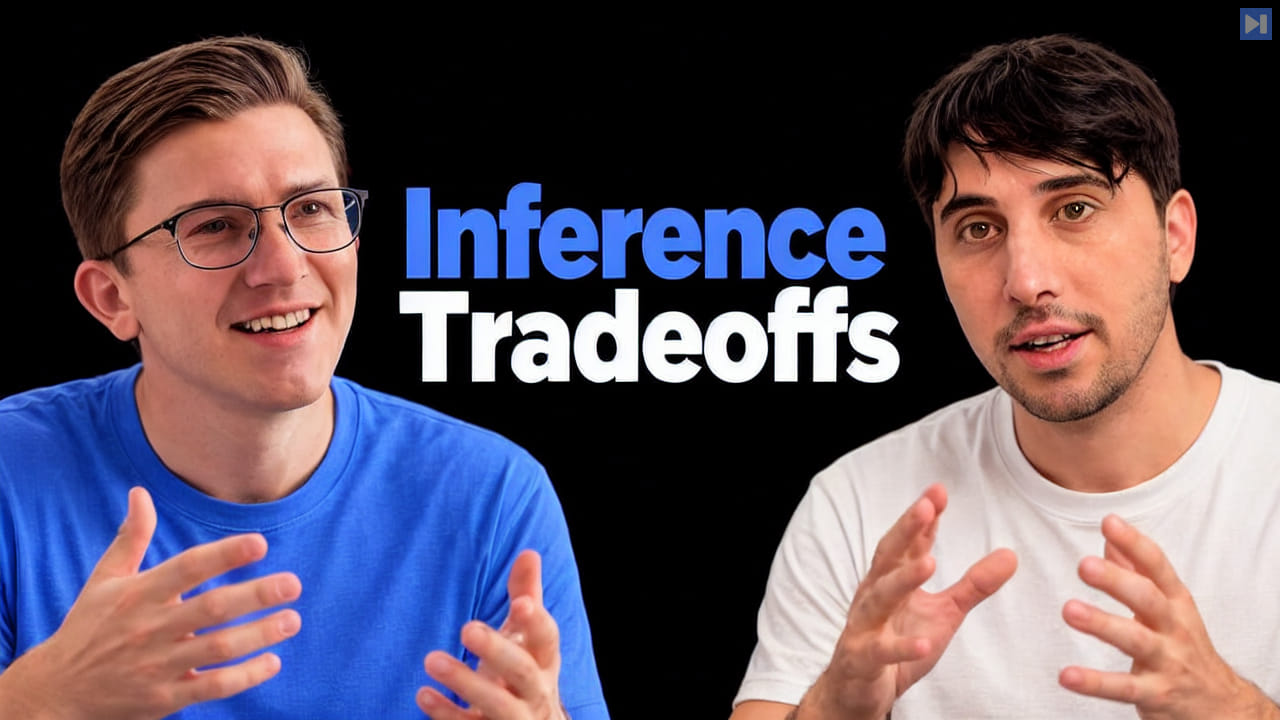
Philip Kiely discusses inference engineering with host 0xSero, distinguishing a model's suitability for a production task from small differences in benchmark scores. He contrasts fitting an open model on local hardware with serving many users at sustained latency, throughput and cost targets.
Philip Kiely explains quantization, mixture-of-experts routing and parallelism as choices whose value changes with batch size and hardware topology. Local users may prioritize memory fit, while a data-center operator must account for many simultaneous requests and the connections between accelerators.
Philip Kiely separates optimization inside the GPU from routing, queues, cache reuse and distributed infrastructure outside it. He describes prefill and decode disaggregation as a specialization strategy that requires sufficient hardware and introduces its own cache-transfer requirements, not a universal fix for a constrained home machine.
Philip Kiely and 0xSero discuss calibration, repeated-token failures and the need to test quality after performance changes. The conversation emphasizes workload-specific engineering and the value of stable model architectures rather than treating every speed improvement as lossless or transferable.
 Watch on YouTube